ReportNextUp '26
SafeSport's CEO to Operators: Check the Database, Then Join the Alliance
Benita Fitzgerald Mosley told NextUp that athlete safety is the base of everything youth sports promises, that background checks miss the Center's disciplinary list, and that a Safe Sport Alliance for organizations outside the Olympic movement launches early next year.
Reported at LeagueApps' NextUp '26 Youth Sports Conference · Oct. 14, 2026 · Civic Hall, Union Square
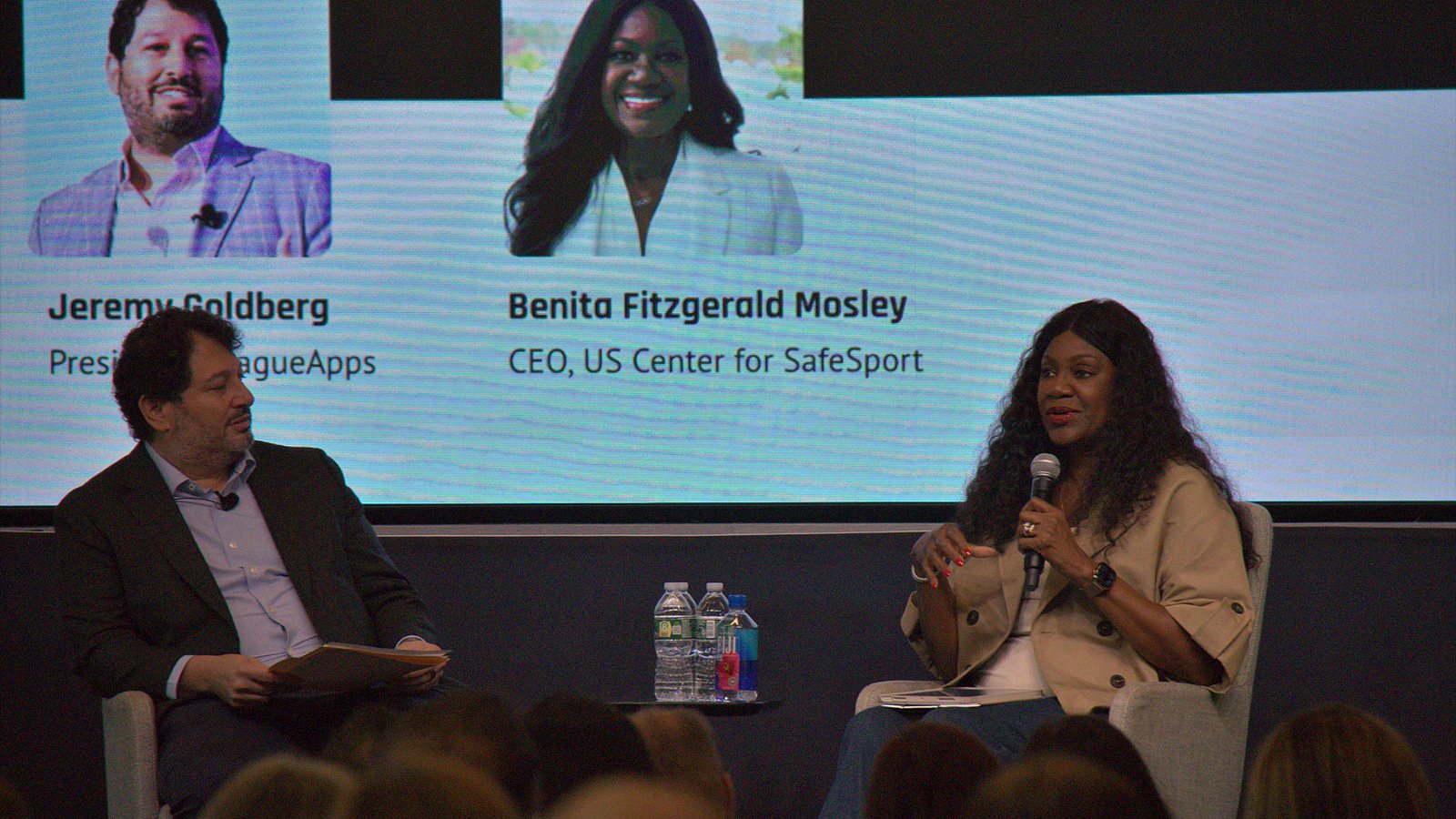
On stage: Benita Fitzgerald Mosley, CEO, U.S. Center for SafeSport, 1984 Olympic champion and former LeagueApps executive · Moderator: Jeremy Goldberg, president, LeagueApps
The whole athlete, safely
Asked what great youth sports organizations do, Fitzgerald Mosley pointed to the sports-based youth development groups she worked with at Laureus: small, often mom-and-pop programs of 100 or 300 athletes that coupled performance with leadership and youth development. "It was so interesting to see how you can do both things."
Her own career, including the gold medal, "are the gifts that keep on giving," she said, citing the familiar statistic that 93% of female executives played sports. But eight months into the SafeSport job, she has arrived at a simpler frame. "Athlete safety is really the foundation of all the promise that sport has. If the athletes aren't safe, none of that is possible."
What SafeSport does, and where it stops
Congress created the Center about 10 years ago in the wake of the Larry Nassar scandal, and its jurisdiction is the Olympic and Paralympic movement only. Inside that world, she said, it sets policy, requires prevention education for adults, audits the national governing bodies, investigates reports of emotional, physical and sexual abuse, and sanctions people. More than 2,600 of them are on a centralized disciplinary database anyone can search on the Center's website. Goldberg noted that the Center handles close to 10,000 reports a year.
"The rest of you have independent organizations who are going about your day," she said. As the mother of a college athlete, she admitted she never once asked whether a coach was safe. Her ask of the room: before you hire or engage anyone, check the disciplinary database, because standard background checks don't. A sanctioned coach can leave the Olympic system and turn up at a school or an independent program, which Goldberg called the vulnerability in the system. The Center is working with the background-check provider NCSI to close that gap, she said.
Observable and interruptible
SafeSport doesn't employ coaches or athletes, so it depends on organizations to recognize what a safe environment looks like. The core of its minor athlete abuse prevention policies is that interactions between adults and minors be "observable and interruptible," two words she asked the room to keep: no one-on-one meetings, no private text messages, no rides home, no time alone in a locker room.
Goldberg added the economics. Insurance costs are up about 18% on average, he said, and rates get set on the risk of the whole category. "If one organization's not safe, but you're doing the safe thing, ultimately the insurance company is going to figure out what the risk of the category is."
Congress is paying attention
She pointed to the Washington Post's recent reporting on abuse cases at the AAU, which had promised to adopt safeguarding similar to SafeSport's, and said Congress is now holding the organization to it. Lawmakers are also looking at private youth sports and NIL. "I believe that it's all going to come to some point where there's going to be a reckoning," she said, when people realize that dealing with one segment isn't enough.
Safety doesn't cost performance, she argued; the national governing bodies with the strongest safeguarding policies keep producing medals, and she pointed to USA Hockey, which was in the room.
Why not me
Her leadership advice was the speech she has given for years. Weeks before the 1984 Olympics, sitting on the track at Tennessee, she caught herself hoping to make the final and run a personal best. Then: "Why not me? Why not me get to be on the top of the podium?" She walked into the Coliseum feeling she owned the gold medal and won the 100-meter hurdles by four hundredths of a second.
The Center will launch a Safe Sport Alliance in the first quarter of next year for leagues, organizations and corporations outside its jurisdiction, with policies, training and reporting guidance. She hopes operators will join by the opening ceremonies of the Los Angeles Games.
The Coach's Board take
Two things to do this week. Search every coach, trainer and volunteer in your program against the SafeSport disciplinary database, since your background-check vendor almost certainly doesn't. And write "observable and interruptible" into your coach agreement in those words; it's the clearest standard we've heard for the gray areas parents actually worry about.
Free. Join the founders, operators and coaches building youth sports.