
ReportNextUp '26
What Breaks When You Grow: Uniforms, "Absolutes" and the M14 Way
Four operators serving tens of thousands of athletes described the moment their way of working stopped working, and the systems that replaced it, from a 6,000-uniform mess to a hiring process that ends on the court.
Reported at LeagueApps' NextUp '26 Youth Sports Conference · Oct. 14, 2026 · Civic Hall, Union Square
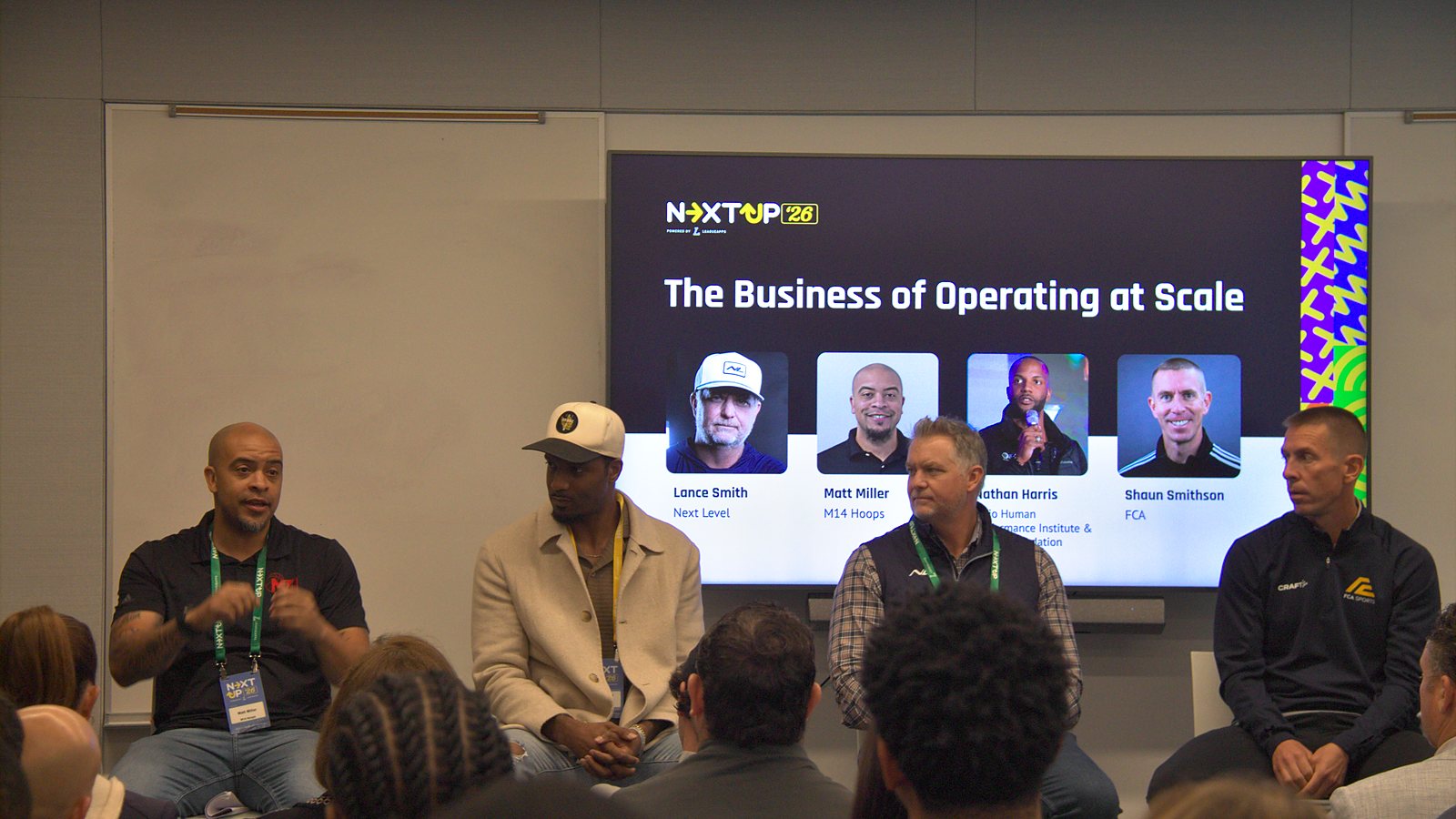
On stage: Shaun Smithson, EVP of club sports, Fellowship of Christian Athletes · Lance Smith, co-founder and CEO, Next Level Sports · Nathan Harris, chairman of the Harris Family Fund and principal, Ohio Human Performance Institute at Spire · Matt Miller, founder, M14Hoops · Moderator: Melissa Macaluso
The room
Smithson calls himself "the water boy of club sports" for FCA, which runs about 107 clubs with more than 350 staff worldwide and roughly 30,000 athletes. Smith's Next Level Sports operates in what he calls competitive rec, a level above parks and rec, across 30 states, including girls flag football and a program at Columbia University. Harris runs a family fund and works out of Spire, the 800-acre academy and boarding school in Ohio, where he brought venture capital onto campus and benchmarks every athlete against a database. Miller started M14Hoops with one client outside Chicago, built a six-court facility in 2007 and now franchises the model.
"We can't all do it our own way"
FCA's clubs grew up as ministry run by former athletes and coaches who decided they could run a league. The philosophy was go for it, Smithson said, so one club used TeamSnap, another LeagueApps, another its own checking account. "That was happening all over the country," until the organization had no idea what was happening. The hard part was telling people who were doing their jobs well that they couldn't do it that way anymore. The fix was a short list of "absolutes" and a longer list of "strongly suggests," leaving room for people to be the artists they were hired to be.
Smith's breaking point was uniforms. At 25 partners, Next Level shipped them in bulk to directors to hand out. At 6,000 participants, uniforms went missing and had to be replaced at Next Level's cost. "What are we doing?" He moved to direct-to-home fulfillment. Every year, he said, the company looks for the operations that would cap its growth without a different way of doing things. Three or four ceilings so far.
The M14 way
Miller's turning point came from an early adviser: the moment you take a picture, you're in business, and McDonald's fries taste the same everywhere even with a 16-year-old at the fryer. So Miller wrote manuals on everything: his player development system, what time he shows up, his dress code. "How do I get this next coach to be me?" The language is standardized too. At Duke it's a ball fake, not a pump fake; at M14 it's whatever the M14 way says, so a session in Indianapolis or Arizona matches Chicago. That documentation is what makes the franchise sellable.
His hiring process is the most concrete thing we heard all day. After the interview, candidates spend three days on site: two days watching training and practice sessions and answering written questions about them, then "the hot seat," live on the court with a director, playing a mirror game. "Watch how I clap and use my voice. Okay, you go." Everybody sounds great in an interview; he needs to see energy and accountability. His first employee came in at $22,000 a year and is still with him, now running headquarters, "because I poured into them so much."
Smithson's version is a coaching model he borrowed: I do, you watch. I do, you assist. You do, I assist. You do, I watch.
What an investor looks for
Harris said it took a lot of shopping to find Spire, and the shopping taught him what he won't fund. "You were inefficient with the money you have, so why would I give you more?" Most operators can't say where their cash runway is. Youth sports isn't venture capital, he said; each organization needs nurturing, so he looks for a founder worth nurturing and for identifiable percentages that show where the waste is. Many nonprofits in the room, he added, aren't financially literate enough to start the conversation.
Asked later how to find the right investor, he described a deck he'd received the night before: 275 students, a clear path to 460, and an IRR. "I'm not interested in keeping your lights on. I'm interested in helping grow." Show him the cost to acquire a student against lifetime value. "You don't have to even be profitable. You just have to calculate."
AI, with a line
Smith wants operators to stop spending 90 minutes in Photoshop and to run their three-year-old parent emails through ChatGPT: "Don't replicate it, rewrite it." Smithson drew the line where personality lives. His LinkedIn posts are cleaned up by AI; his texts to his daughter are not, because "she'd be like, that's not you, Dad."
The Coach's Board take
Every story on this panel broke at the same place: a process that lived in one person's head. Write the M14 way for your program this off-season, even if it's three pages, and decide which rules are absolutes. And if you ever plan to raise money, start tracking two numbers now, what it costs to acquire a player and what a player is worth over their time with you, because that's the first thing Harris asks for.
Free. Join the founders, operators and coaches building youth sports.