THE FACEOFF · EPISODE 7
Episode 7: Nick D'Errico & PointShot — Not a Goalie Shortage, a Coaching Shortage
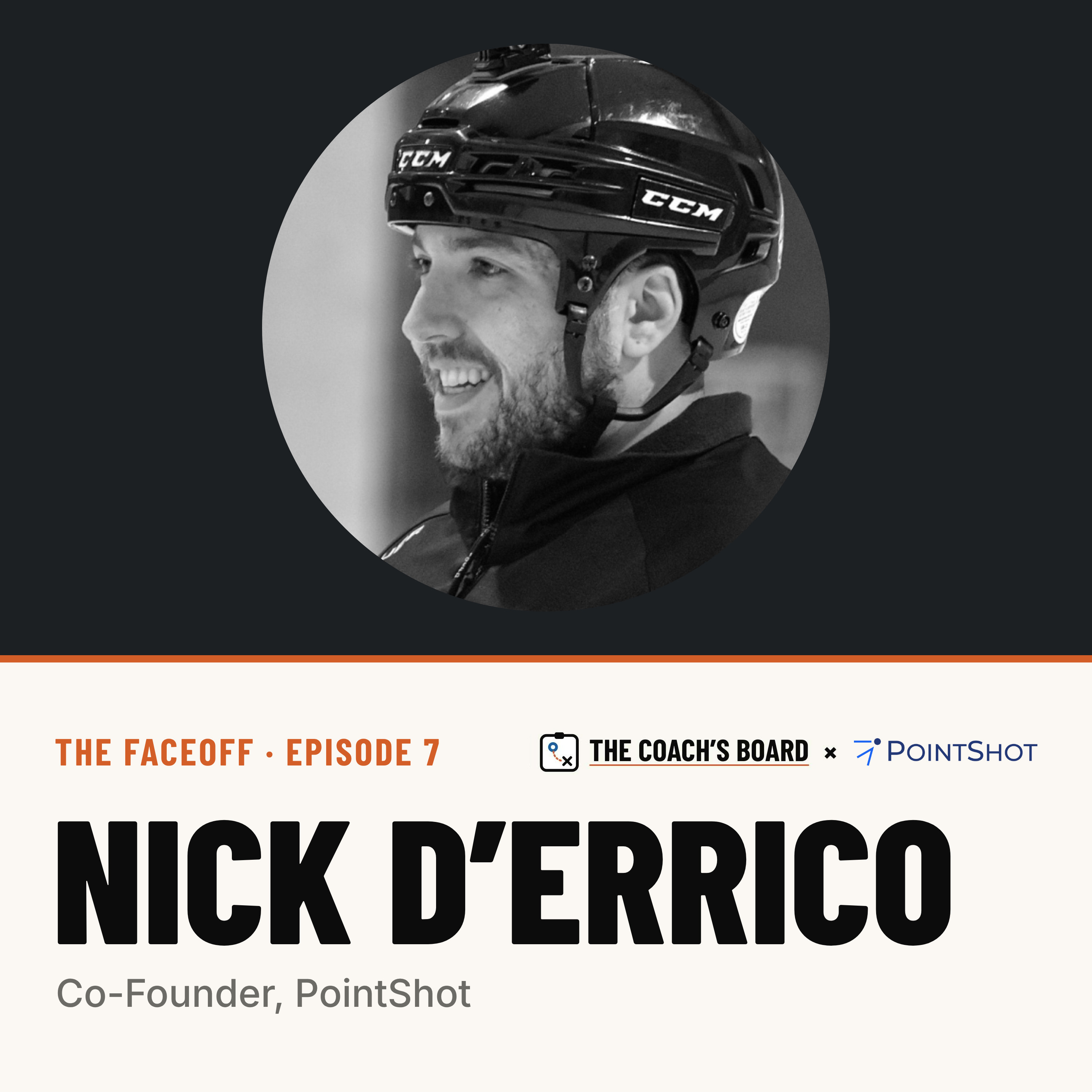
Nick D'Errico · Co-Founder, PointShot
The guest

Nick D'Errico
Co-Founder, PointShot

Fifteen years coaching goalies, from Learn to Play through NCAA and professional hockey. Nick D'Errico owns D'Crease Goaltending, coaches the goalies for Worcester State University's women's team, and is a USA Hockey Gold-certified goaltending coach from the very first class to earn it. At a youth club in central Massachusetts he built a goalie program from scratch, from nine goalies to 40. Now he's the co-founder of PointShot, an online athlete development platform and coaching marketplace built so any kid can find a coach who will invest in them.
This is Episode 7 of THE FACEOFF, and our first from the crease: thirty-two minutes with Nick. Paul sat down as a team coach whose bench had seven skaters and no goalie, fresh off USA Hockey's Bronze goaltending course. Nick's argument is that it isn't a goalie shortage at all. It's a coaching shortage.
WHAT'S IN IT
• You don't have to be a goalie to coach one. A line USA Hockey uses too, and Nick's first instruction to every team coach: teach the game, not technique. Design every drill around a scoring opportunity, ask a guided question instead of yelling about the puck, and let the kid figure it out.
• Nine goalies to 40, one clinic at a time. A loaner gear library that outgrew his garage, quick-change gear and rotating goalies at Mite and Squirt, no full-time goalies before Peewee, Bantams mentoring the younger kids, and a goalie station at Learn to Play. A month into this season: almost two goalies a team across 18 teams.
• Goaltending has a branding problem, and parents own the brand. The most protected player on the ice, pictured as the most dangerous spot. His fixes: lower the barrier with quick-change and secondhand gear, equipment help like GearGiver, and a tap on the pads after the big save.
• Quality reps, not more reps. Why over-specialization is one of the biggest risks to a kid's love of the position, self-determination theory in two minutes, and why a goalie needs to miss hockey now and then.
• PointShot, a connector for coaches who care. Nick and his co-founder, Lou, met through USA Hockey and rebuilt a video platform into a marketplace: free video tools for athletes, a business for background-checked, certified coaches, and organizations next.
• Rapid fire. Marc-André Fleury, a Russian street dog named Floki in net, and the Monday-morning ask for every club director, team coach and goalie parent: check in with your goalies.
Nick's goalie drill library, free for every ice hockey coach: https://dcreasegoaltending.com/drills
FIND NICK AND POINTSHOT
D'Crease Goaltending: https://dcreasegoaltending.com
Instagram: https://www.instagram.com/pointshotapp/
LinkedIn: https://www.linkedin.com/company/pointshot/
Nick on LinkedIn: https://www.linkedin.com/in/nicholasjderrico/
The written version of this conversation is THE FACEOFF VOL XIII, free at https://thecoachsboard.com. If you run a club, a facility, a league or a team, or you're building something for the people who do, we'd like to hear from you.
The Coach's Board is the community building youth sports. Home of The Faceoff Podcast.
Instagram · X · TikTok: @thecoachsboard
Transcript
Paul Variano Welcome in. This is The Coach's Board, the playbook for modern youth sports. I'm Paul Variano, and every episode we sit down with someone who actually runs this game. My guest today has spent 15 years coaching in the crease. As a coach, he's worked with goalies from Learn to Play all the way through NCAA and professional hockey. He owns D'Crease Goaltending. He's the goalie coach for the Worcester State University women's ice hockey team. And he built a grassroots goalie program from scratch at a youth club in central Massachusetts. From nine goalies to 40, he supports education seminars for other coaches on how to coach the position with Massachusetts Hockey, and he is a USA Hockey Gold-certified goaltending coach, part of the very first class to earn it, one of 20 in the country, with a published thesis on how to evaluate a goalie as a whole person, not a save percentage. His coaching starts with the whole person, not the save. Healthy habits, confidence, and a lasting love of the game, so the kid who tries the position once wants to come back. Now he's building the place where any kid can find that kind of coach. He is the co-founder of PointShot, an online athlete development and coaching marketplace. Nick D'Errico, welcome to The Coach's Board.
Nick D'Errico Thanks for having me, Paul. That's a hell of an intro.
Paul Variano Thanks for coming on, Nick, we really appreciate it. So let me tell you why this one's personal. Because when I said goalie coach, some of you reached for the skip button. I coach a 7U travel team. Every practice there's a kid standing in the net with 40 pounds of gear on, and every coach on that bench, me included, is a skater. We can teach a crossover, we can run a breakout. Nobody on that bench can tell that kid what to do with his hands. I played college hockey, I still can't. And it's not just my team. Ask any club director what they're short on, and the answer isn't ice time or money, it's goalies. Nobody wants to play it, nobody wants to buy the gear, and nobody on the bench knows how to coach it. So the kid who tries it once gets scored on nine times and never comes back. Nick's argument, and he's got the receipts for it, is that it isn't a goalie shortage at all. It's a coaching shortage. He took one club from nine goalies to 40, and now he's building the thing that would have saved me a lot of Tuesday nights. A place where a club like mine can find a coach like him. So today, why kids walk away from the position, what actually develops a young goalie, how to coach one when you're not a goalie coach, and what a marketplace for coaching looks like when the customer is nine years old. No save-percentage talk, just two coaches, one of whom knows what he's doing in the crease. So, Nick, take me back to your youth playing days. What did you experience then that 15 years later has led you to where you are now? Tell me about your Allston-Brighton days.
Nick D'Errico It was about 2012. I was playing for Emerson College club hockey. And I was a referee as my college job. I refereed this team from Allston-Brighton, Peewee team. Heck of a coach, great person. I could see the smiles on all the kids' faces. As a ref, unfortunately, in today's game you take a ton of abuse. This was one of the first times I had seen a team who really did it right, absolutely respectful, supporting each other. I figured, if I'm gonna see the game from multiple sides, I'm gonna try coaching. I had a lot of opportunities into college that I really felt like I had to give back for. I go out there first practice and I see that the goalie doesn't have that much guidance. This is a kid who no matter how he does, just loves being in there. I see the opportunity to be something that I never had, which was a coach who could take a personal stake in the kid and really be that mentor.
Paul Variano Most people who coach goalies were goalies. What's your version and what does that give you that a skater turn coach doesn't have?
Nick D'Errico I would argue that you don't have to be a goalie to coach goalies. That's a line that USA Hockey uses as well, where as a team coach, you're there to teach the game, we have skills coaches to work on the technical aspects. It's easier for a former player to teach players more of the nuanced skills, but as a team coach, your goal is to teach the game. For a goalie, they can get technique from any third-party goalie coach. I would even argue that we should kind of pull away from the over-technical coaching, because really the goalie has to discover for themselves what works. But as a team coach, teach the game, teach how to read the play. What should the goalie anticipate happening? What should they look for in shooters and threats on the ice? When you're developing practices and drills, what I always tell the team coaches in my organizations are design around a scoring opportunity. And then make sure the goalie knows, like what am I getting out of this? I think that's the most helpful way for a team coach to make a goalie feel like they're part of a team. And then, bringing in a goalie coach for a practice a month, know, encouraging the kid to seek that technical training on the side, that's where they'll get the technique aspect. I would even argue, limit it, because their gameplay decision-making should be intrinsic. It shouldn't be, I did this because coach said to.
Paul Variano I think about what you've been able to do throughout your coaching career as a goalie coach, and with the Revs, when you went into that organization, were these things that were already being done? How did you go about implementing them? What was the process in doing all of that?
Nick D'Errico So Back when I joined, it was originally the Starhawks. I had met one of the directors actually playing pickup hockey on Friday nights. He was like, hey, we don't really have a goalie coach. Why don't you come in and just work with the kids, give them some guidance? Coming in, I think the problem was the same thing that a lot of organizations deal with. You have less than one kid a team. And you have a lot of kids who don't want to try because either they have this preconceived notion or the parents have this preconceived notion of what goaltending is. The kids just like to be out there and score. But really there's nothing driving them to want to try the position. And so I come in, really, it starts with a clinic a week. Just getting the kids who are already goalies out there, getting them some guidance, but above all, it's making things fun, making goaltending enjoyable. Where in today's day, when you are the goalie on a team, right? you are the guy. The pressure is on you, you're playing whole games. And at the end of the day, you're a kid. You don't learn these skills, like resilience, absolute cold turkey. right? It has to be a nurtured skill. So we start with clinics, and that branches into some other programming. So we did loaner gear. We have an entire loaner gear library. It's outgrown my garage at this point. But any kid who wants to try the position or any kid that outgrows some of their gear can always have something to borrow until they find the time to get it. We do quick change and rotating goalies at the Mite level and even the Squirt level. We try to at least get kids in. We also put in place that there's no full-time goalies before Peewee. I know that's tough because a lot of kids are dead set on wanting to play goalie, but you have to learn, there's so many skills you have to learn. You have to learn how to understand the play. You have to build your skating skills because I think we've all heard goalies are the best skaters on the ice. So there's a couple of policies and structures we put in place. And it's it's grown. We've had kids who come out as shooters to goalie clinic and then they realize, I want to put the pads on. Can I borrow some? And they have the most fun they've ever had on the ice, and that just sets up a lifelong passion. We have our oldest goalies come as mentors. So if you're a Bantam or above, you're expected to mentor the kids below you. I have my college kids coming back to work with the older kids. And that's even branched into Learn to Play, where we'll do a tri-goalie station. You get the big kids coming out there, and you can see the impact of the moment when a little kid looks up at one of the big goalies and goes, You're the coolest person I've ever seen. I want to be just like you. We started with less than a goalie per team. Every year we have the exodus to club hockey, and that's expected. I love when my goalies get to level up and experience higher competition. And of course everybody inevitably panics. What are we gonna do about goalies? And then we just build more. And I think this season we're we're a month or so in. And we've gone from one goalie a team to almost two per team across 18 teams.
Paul Variano Nick, do you lead the Bronze goaltending course for USA Hockey?
Nick D'Errico No, I don't.
Paul Variano I just did it this past week and I don't know, if they don't have you as an instructor, they should. USA Hockey did an incredible job this past week of doing a deeper dive into what you just shared around really the difficulties around goaltending. What do you think parents get wrong about the position?
Nick D'Errico I'm gonna steal straight from Steve Thompson, which is, goaltending has a branding issue. A lot of parents just have the notion that it's the most dangerous position. In reality, it's not. You are the most protected player on the ice, both from a gear standpoint and a rule standpoint. I think it's just because, oh, you have projectiles coming at you. It's a notion from the days when, oh, goalies are weird, right? They're standing in front of things, it it hurts. The game is so different, the gear is so different. But even beyond that, it's the expense thing. My kid's gonna have the most expensive gear, and know, there's also the mental part. Like I think we all know that. Goaltending is a lonely position. You're very individualized and specialized, just like a pitcher in baseball. Building the culture and supporting that, reducing the barrier to entry is a big one. And that's why quick change gear has been such a huge development. Vaughn, Bauer, they do a great job with the quick change and just making it so that families don't have to worry about the purchase until their kid is fully ready to commit. Also breaking this culture. Hopefully gear companies don't get at me, but you don't need the top-level gear. Secondhand gear. So many goalies in secondhand gear and it works great. skip Reducing the barrier to entry is a huge part of it. And then the final part is making the goalie feel like a member of the team, building the culture with your players where the goalie makes a huge save, you go up and tap them on the pads and encourage them. The goalie's having a rough night. Your team knows to say, it's okay. You've got this. Building that culture among your players and the parents. Because at the end of the day, right, the kids repeat what the parents say. They form their opinions based on the parents because they're children and when you realize this is who we have, this is who our last line of defense is, the best thing you can do is support the goalie. That builds a positive, supportive culture. You can't argue with the smile on a kid's face, right? The hard truth for parents is it's their dreams, it's their passion. Just nurture it. Sometimes we feel like, oh, we are being supportive. I want my kid to be happy, but it comes down to the body language you show as well. the The best thing is when a kid tries it on, they go, This is the most fun I've ever had, nurture that. Just embrace it, support them. There are plenty of resources beyond just a an organization providing gear. I think it's called the GearGiver, where you can apply for donations for equipment. You can't argue with the smile on a kid's face when they come off.
Paul Variano Yeah, on their face, you get past the parents' concerns on safety, cost, and everything else. And Now you got them hooked. Me as a coach, as more of a team skater coach, how do you continue to give them that love of that position when they live more on an island compared to the rest of the team, how do you ensure that once they are hooked on, you do get to that point of specialization, that you're providing them the right resources to to continue to grow?
Nick D'Errico I think part of it is not overly specializing. The kid needs to learn the game first. Giving them the opportunities to skate out is absolutely huge, to take a break from goaltending. And I think you mentioned specialization. I think specialization is one of the biggest risks for a kid to retain their love. In our North American culture, we're just used to putting kids on the ice five days a week. And then over the summer they're playing, and in the spring, and your kid needs to take a break. They need to miss hockey. And especially they need to miss goaltending. And even then, I love the concept of self-determination theory. There are three base needs. Not Maslow's hierarchy, very different, but it's autonomy, relatedness, and competence. And you need all three in balance. right? Relatedness is feeling you belong amongst the group, competence is I know what I'm doing, and autonomy is I have control over my destiny and what I'm doing. Building a love of the position is nurturing all three, making the goalie feel like, I'm supported on this team. I I think it's tough when you are the guy and all the eyes are on you. There is the autonomy, and that's where I was getting at previously, where you don't just overcoach and make the kid think that, oh, I have to do this technically because that's what coach said. They need to figure out the effective and efficient response based on what's happening in the play. And then competence is I feel like I know what I'm doing and if I mess up, well, I can treat it as a learning moment instead of a fault in my character. So I think nurturing all three and keeping those in balance is one of the critical things to keeping a kid's love of the position, even in the toughest times.
Paul Variano I love that advice and I'm I'm definitely gonna take that back to my teams and my coaching mentality and my attitude. Everything just described, I guess I'm gonna try, but there's thousands of coaches like me who don't get this valuable information, perspective, advice, and there's only one of you. So how do you go about scaling, sharing this, critically important value-added information?
Nick D'Errico Well, I would encourage anyone to take USA Hockey's Bronze goaltending course, Silver if you're so inclined, if you're really nuts, go for the Gold. But that just provides such important base context into USA Hockey's system of supporting goaltenders. If you're in Massachusetts, my ACIC of goaltending, Cam Earl, just introduced the Mass Goaltending Collective. So That's going to be a series of monthly calls, workshops, published education, some on-ice stuff where it's completely free of charge, but we're offering free free resources to support the goalies and educate the coaches who support them. There are so many resources online. InGoal Magazine is one of my favorites. Shout out to those guys. We're even seeing published research now. One of my friends and colleagues, Nate Spidel, just a couple of years ago finished his dissertation with University of North Dakota on self-determination theory in goaltending and the impact on performance. If you're a real nerd like I am, go for those dissertations. The other thing I'd I'd recommend is just go talk to a goalie coach. I think we have this mindset of gatekeeping, and there are plenty of goalie coaches who reject the gatekeeping in private coaching, and you will be able to find someone to give you advice, and I'm always happy to be a resource for anyone.
Paul Variano I I appreciate that, Nick. What's the most common thing a a team coach says to a goalie that they should never say?
Nick D'Errico I think it's just the, well, you should be doing this. Old-style coaching ends up being so prescriptive. The most important thing that you can do as a team coach is teach the game, not technique. I think we have a lot of coaches who, they want goalies to handle the puck, and then they yell at them when they cough up the puck. And a kid doesn't just come in with these skills, they have to learn them. But the way it really sticks is when the kid figures it out for themselves. And as a coach, a kid is gonna try and you can really hinder that or just completely kill it when you're just telling them that was a dumb play. Unfortunately, I hear it far too often. It's just, if you've taken any of the USA Hockey CEPs, the most effective means of coaching any player is approaching with curiosity, asking questions. I don't think we've fostered a lot of critical thinking in kids because we don't ask them to think about why. So asking guided questions and getting them to figure it out. I think that's one of the most helpful things. And just realizing right. these are kids. I mean, any any means of learning is making mistakes and learning from them.
Paul Variano You have so much of a domain expertise in this, Nick, and the the Worcester State University women's team is so lucky to have you as their goaltending coach. I think about my clubs and I'd love to hire someone like yourself to come, but unfortunately, I don't think we could afford you. So—
Nick D'Errico No, it's— honestly, I try to keep costs down as much as possible. Goaltending and— it's tough when you're trying to make it worth it. And goaltending is a highly personalized thing, so you're running one, two goalies at a time, so the costs are definitely higher. But you know, I think goalie training doesn't have to be as expensive as folks make it out to be. Your kid doesn't need to be out there five days a week. If you find the right supporting coach, it's about quality reps, not more reps. Getting a coach who will provide sufficient guidance one week and then you can take a week, two weeks, three weeks off to really let that guidance stick.
Paul Variano And I'm guessing that's where PointShot comes from.
Nick D'Errico PointShot is about finding the coaches who will invest in their athletes and give the quality reps versus quantity, making sure the passion is nurtured and that the player is really understanding what development looks like. I think we're so used to instant gratification where all we know is the result on the ice in front of us, but that's not necessarily an indicator of growth. Growth is 1% better every day. It's hard to see that day to day. I think that's why we have kids out there so much is that, well, my kid not must not be getting better. He didn't score more goals or he didn't make more saves this week. But when you're looking at the result on the ice, you don't see the improvement in their processing of the game. You don't see the improvement of how they play off the puck. And especially you don't see that evolution in their enjoyment.
Paul Variano You mention a lot of different parts of the youth sports ecosystem there. We talked about coaches, parents, the young athletes themselves, clubs. Who is the customer? Who's it meant for? What parts of the ecosystem does it touch?
Nick D'Errico So PointShot is about helping families and the athletes. At the end of the day, my co-founder Lou and I are both coaches. I've been a coach for 15 years. Lou's been a coach for 35. It's just the day-to-day that we live. It's The platform is based on everything that we've learned, everything that we've seen with athletes and coaches. So as I said, athletes need the guidance from folks who will invest in them and be supportive and not create that reliance on a coach. From the coaching side, we're trying to give them the ability to own their own business as well. There are so many good coaches who coach with that ethos, but starting a business is one of the hardest things you can do, and we want to provide an avenue for them to spread their message. We give them all the tools they need to start, run, and grow a business, including delivering the feedback through the platform, marking up video. And something else we're moving into are organizations. So you have associations with two, three, four hundred athletes. You have know, 20 kids on a team with one or two coaches. Maybe you have a skills coach plugged in, maybe you don't. It's hard for a kid to get one-on-one time. And That's where they're going off on the side, finding private coaches. Maybe it's quality, maybe it's not. The messages are mixed. And It gives organizations the opportunity to find, maybe partially subsidize or strike a deal where you get an org discount and you find those coaches who can enhance the value that your organization adds. And It's not just related to position coaching, hockey coaching, but it's mental performance, it's nutrition, it's strength. We're trying to bring in specialists of all different expertise to provide the full scope of development and resources that that a kid needs.
Paul Variano I I absolutely love the product. I'm looking forward to introducing it to my club president. We have a catch-up call in a couple of weeks, and I know for a fact, even when I was playing travel hockey twenty-something years ago, I was getting one-on-one private lessons. And you're absolutely right, in the team practice environment, it's tough to get that individualized skill attention that you need, both for a player and even more for a goalie. And that's why we have this goaltending USA Hockey pathway. So goalies aren't just showing up and just taking shots the whole time. I think what you're building is great. I think it's beneficial to every part of the ecosystem. You're lowering costs for parents, providing a more seamless experience for them. Also, with the clubs themselves, they can triangulate and find you know, where price can help them out and help increase the value that they're providing to their athletes and their coaches. I'm looking forward to it and hopefully we'll we'll be connecting offline in a couple weeks to talk about that. But this wasn't the first version you got to with PointShot, like any founder, where you thought your idea was never ends up being where you— maybe striking success, but where you see a lot of potential growth. Tell me about sort of the evolution of of where you started into where you are now with PointShot.
Nick D'Errico I can't take the credit for it, but Lou started a business called Stream Cortex almost 10 years ago, and Stream Cortex was a real passion project for him as one of of the first video review platforms for organizations, and it was very much intended for i schools and youth orgs who couldn't afford the huge video review platforms like Hudl or InStat at the time. This was really a passion project. Lou raised two kids through hockey and just did it to support those organizations, make sure that the coaches had a way to review game film, make sure that the kids had their own way to build that self-awareness skill and break down their own footage. I mean, Stream Cortex, Lou had viewing centers as well and a couple of rinks to really provide that environment that coaches and and athletes could interact. Now over time, InStat was bought by Hudl. There's an explosion in video review solutions, and when Lou and I met, he was starting to work on this booking idea for lessons, the sales of remote video review, even evaluations. And That's how we got connected through USA Hockey, where I was doing my thesis. And we worked on it for a while together and realized, the key part of this is the marketplace. Everyone is trying to do video review software, even getting down to the youth levels at this point. But the big gap is the quality coaching, the sheer guidance that's needed. Another component of that is the parent trust. Do I feel like my kid is getting better? How do I track that? Do I feel like the coach cares about my kid? It's not just another number. That was really where we pivoted into PointShot rebranding, building the platform on a modern stack from scratch. And since that, we were fortunate to be accepted into an accelerator program. We have a little funding through Auxilium, the program, which is owned by the Ruckers who own the Worcester Railers. Our mission has never changed: supporting the athletes, helping them build self-awareness. Athletes get all the video tools in the platform completely free. You can upload and break down your own footage and keep those notes. But we wanted to ultimately be that connector for coaches who care.
Paul Variano That's awesome. I completely see your vision. c Connecting coaches that care. It's a simple slogan, but it's so powerful. I think what you're building is great for this community of coaches like myself that are team coaches, even for parents or club directors, there's so many parts of the ecosystem that I think you're tapping into that can really benefit from it. Almost coming to a close here before we let you go. It's Monday morning, a club director, a team coach, a goalie parent, all just walking. watched this. What's one thing you think one of them should do this week?
Nick D'Errico one The one thing that I'd want you to take away is: check in with your goalies. They need to feel like they're seen. Both the goalie parents and the goalies themselves. It might take a minute or two to get to the real meat and potatoes of of how they feel. You should make sure that they feel seen, that they feel they're part of the team. Do they feel like they're getting something out of practices or do they just feel like they're a target? I would definitely take that self-determination framework into mind. Do you feel like you know what you're doing? Do you feel like you're part of the team? Do you feel like you can make the decisions in the game? You have the freedom to make the decisions on how you play. From there, that's really how you build your framework of what to tackle first and building up your program. Do I start just with team culture? Do I start with getting pad resources and and rotations? Do I just start on getting clinics started? Or do we educate our coaches in more coaching the game and gameplay versus skills?
Paul Variano Check in with your goalies. And I think that's sort of the decision tree, sort of takes you from there to all the different resources you just mentioned, the act the call to action. But the most important thing, very easy to forget and and not check in with them because they are quiet. They are an island. Nick, really appreciate you coming on. So Before we let you go, we'll do a rapid fire, one at a time. So first question: the goalie you'd pay to watch, any era.
Nick D'Errico I've already paid to watch so many of them, but I modeled my college game off Marc-André Fleury. Although I really don't like the Penguins. He was just one I love to watch and how he flows and how he just has so much fun with it and he's not afraid. Even in the modern game, a couple of years ago, he's not afraid to throw a pad stack or a huge poke check. Nobody loved the game like he did. And I got to watch his return to Vegas back a couple of years ago, and that was a heck of a game to watch.
Paul Variano That style of goaltending— I think about Tim Thomas or or Hasek with the
Nick D'Errico Mm-hmm.
Paul Variano double pad stack or that more unorthodox methodology of trying to stop the puck. Number three: the drill you'd ban from every youth practice tomorrow.
Nick D'Errico Oh, it's a tough one. I don't see it as much anymore, so I think it's going by the wayside. You send three players with pucks around a circle and it's bam, bam, bam right from the top of the circle, and the goalie has absolutely no time to reset. I think you need your goalie to be able to follow a puck, even if they don't follow it on their feet, at least looking away, right? Game realism: you don't get three shots in quick succession from the same spot. But I also taking away flow drills, because flow drills, again, are just— you're getting the same shot from the same spot all the time. And make sure you build in variation so your goalie has that— builds that sense of how to adapt based on where the play is.
Paul Variano I like it. That's what they taught us in the goaltending Bronze course this past
Nick D'Errico Mm-hmm.
Paul Variano week. Number four: the most overpriced piece of goalie gear.
Nick D'Errico Sticks. I think that's the most overpriced thing across all positions. I would say sticks, I would also say pads. I think it comes down to: you don't need the top-of-the-line thing. We buy the top-of-the-line thing because that's what the pros have. If you look at the pros, they're not using the top of the line, the newest stuff. A lot of them are using older things skinned as newer things. Buy the second or third price point stick, buy the second or third price point pads or even secondhand pads. What matters is learning, you know, not flashy gear. The gear doesn't make you better.
Paul Variano Yeah. I agree on the sticks. As a player, I could definitely attest to that. It's not the equipment that makes the goalie, but I will say you definitely want to make sure you're getting fitted properly, both from an injury prevention standpoint and also from just good play as well.
Nick D'Errico The one piece to never ever skimp on is mask. As someone who's had multiple concussions, don't be like me. Buy the nice mask. You don't wanna— you wanna develop your brain.
Paul Variano No illegal cat eyes, to those young goalies listening in.
Nick D'Errico Yeah, I can't talk about cat eye 'cause of my masks behind me and my current mask. But for kids, yeah, no cat eye. And no cheater cages.
Paul Variano Number five: your two dogs' names, and which one would make the better goalie?
Nick D'Errico So My two dogs, Floki and Freya. I would definitely think Floki is the better goalie. You throw a ball, he'll chase it down, he'll kill it, and then he'll just walk away like, all right, done. Freya is very smart, very big. But it'll just stand there and stare at you like, what do you expect me to do? She's very much just a loaf and lets Floki do all the work. I definitely think my Russian street dog Floki is the better goalie. And hey, Russian training, right?
Paul Variano Send him to Dagestan then for two years and forget, right? All right, last question, Nick. Where do people find you and where does a coach who wants to be on PointShot start?
Nick D'Errico You can find me personally on Instagram, my website, D'Crease Goaltending. You can see it on my shirt. It's D-apostrophe-Crease. I have an apostrophe in my name and it screws everything up, so I might as well just lean into it. yeah, D'Crease Goaltending on Instagram and then PointShot. So We got PointShotApp on Instagram and Facebook. You can find us on X and LinkedIn and then PointShot.com. If you want to join PointShot.com, if you're an athlete or family, just go register, sign up. You get immediate access to all the video tools, your profile. So you just go get started right away. And then if you're a coach, same thing, go sign up. You'll build out your profile, and we're very diligent about vetting, making sure that everyone's background-checked, everyone has the necessary certifications for whatever your specialty may be. We want those coaches who are going to personally invest in their kids. Families can definitely trust that we have the right kind of coach on our platform.
Paul Variano And when this episode goes out, Nick's goalie drill library goes out with it. So you'll have something to run at your next practice. Nick D'Errico, co-founder of PointShot, thanks for pulling up a chair at the board.
Nick D'Errico Thanks so much, Paul.
Paul Variano Thank you, everyone, for listening and watching. If you enjoyed today's Faceoff guest with interview with Nick D'Errico from PointShot and D'Crease Goaltending, be sure to hit that subscribe or follow button wherever you're watching or listening. Every week we sit down with a founder or leader in the youth sports space and get to hear their story, their journey, their successes and their failures, honest conversations with honest people. If you want the written version, Nick's drill library, and everything else we cover, the newsletter is free at thecoachsboard.com. And be sure to tune into next Friday, when we go international for the first time, Fada Ugwu, the founder of AfriSportPro, a youth football league in Nigeria with more than 120 clubs built so kids get scouted on what they do on the field, not who they know. Thanks, and have a great week.