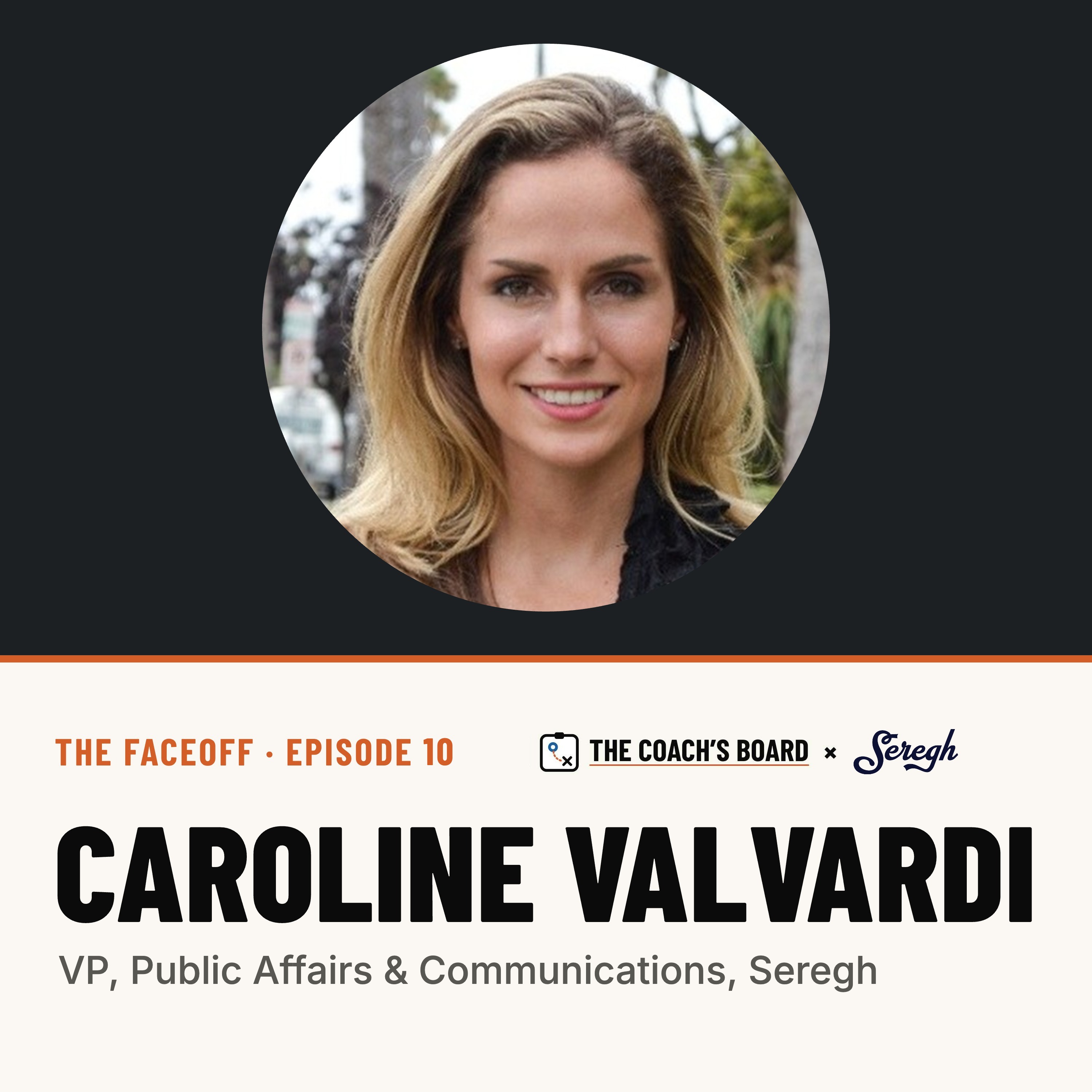
THE FACEOFF · EPISODE 10
Episode 10: Caroline Valvardi & Seregh — Much More Than a Stadium
Caroline Valvardi · VP, Public Affairs & Communications, Seregh
The guest

Caroline Valvardi
VP, Public Affairs & Communications, Seregh

Basketball, field hockey, softball, volleyball and tennis as a kid. An internship with Right To Play in college, then Covenant House and the Philadelphia Youth Sports Collaborative. A career in community development finance. Caroline Valvardi has seen youth sports from the field, the nonprofit side and the finance side. Now she is Vice President of Public Affairs and Communications at Seregh (say "surge"), the spin-off of Harris Blitzer Sports & Entertainment that invests in, develops and operates mixed-use districts around arenas and stadiums. She is usually the one asking the questions, on The ROAR Podcast.
This is Episode 10 of THE FACEOFF: thirty-five minutes with Caroline. Paul came in with one question: when a billion-dollar district goes up around an arena, where do the kids who live next to it fit in? One thing she made clear on the episode: she believes community development finance can play a valuable role in developing successful districts and hopes to bring more of that into these projects.
WHAT'S IN IT
• A district is much more than a stadium now. The area around a venue used to be a fan zone: a few bars and restaurants next to the arena. Now housing, retail, hotels and public space get planned together from the start, so there is activity 365 days a year and not only on game day. "It's much more than just a stadium or arena these days."
• The community benefits agreement is where youth sports shows up today. Most districts are public-private partnerships with a community benefits agreement attached. Youth sports usually enters on the nonprofit side, as funding for a local organization serving under-resourced kids. Caroline expects more of it to be physical, with fields and facilities written into the master plan.
• Her thesis: bring community development finance into the district. Community development financial institutions, or CDFIs, are locally based, mission-driven lenders that fund what traditional banks often don't. This one is Caroline's own view: she sees a win-win-win in partnering with them, because they can help fill capital gaps and help a project show its benefit "beyond the footprint of the district." Her example of what a CDFI can build: the Pullman Community Center in Chicago.
• It has to work 365 days a year, and it has to pencil. Titletown in Green Bay had to plan around the cold, and a waterfront site that looks amazing may only work a few months of the year. How Seregh uses ROAR, its data analytics platform led by Adam Grossman, to find the right mix, why districts get built in phases, and why every idea has to answer how it gets funded.
• Get in the conversation early, and know who to call. Her advice to a club director whose town is talking about a district: research who is involved and build the relationships before anything is baked. Start with the city's economic development arm, then the developer, the team, the architects and master planners, and the broker leasing the space.
• Rapid fire. The best coach she ever played for (her dad), why The Battery is still the early prototype everyone looks to, and the last game she went to purely as a fan: her niece's softball game.
FIND CAROLINE AND SEREGH
Seregh on LinkedIn: https://www.linkedin.com/company/seregh
The ROAR Podcast: https://podcasts.apple.com/podcast/id1866665615
The written version of this conversation is THE FACEOFF VOL XVI, free at https://thecoachsboard.com. If you run a club, a facility, a league or a team, or you're building something for the people who do, we'd like to hear from you.
The Coach's Board is the community building youth sports. Home of The Faceoff Podcast.
Instagram · X · TikTok: @thecoachsboard
Transcript
Paul Variano Welcome in. This is The Coach's Board, the playbook for modern youth sports. I'm Paul Variano, and on every episode we sit down with someone who actually runs this game. My guest today started where most of the people listening did: on the field. She played youth sports. She coached them and she worked and volunteered inside them. Then she went into community development finance, the part of the money world that funds people in places that mainstream finance doesn't traditionally reach, providing access to capital for small businesses, affordable housing, and community facilities like youth rec centers, charter schools, and more. Today, she sits at the intersection of those two lives. She is the Vice President of Public Affairs and Communications at Seregh, which stands for Sports Entertainment Real Estate Global Holdings. A spin-off of Harris Blitzer Sports & Entertainment that invests in, develops, and operates mixed-use districts around arenas and stadiums globally. A key part of her job is the conversation between the people building those districts and the communities where they're built. From Washington, DC, Caroline Valvardi, welcome to The Coach's Board.
Caroline Thank you so much. Thank you for that very nice intro. very excited to be here. So thank you for having me.
Paul Variano Thank you for coming on, Caroline. We're really excited to have you. Here's the thing. Every few months there's a headline about a new billion-dollar district going up around an arena. The restaurants, the hotel, the plaza. Almost nobody listening to this will ever be in the room where that deal gets done. But a lot of them run the club down the street So the question I've had since we met at the summit a few weeks ago at JohnWallStreet Youth Sports Summit what does a district like that owe the kids who live next to it? And who decides? You've been on both sides of that question. You played, you coached, you worked and volunteered inside youth sports. Then you went into community development finance and now you're at a company that builds those districts. So today I want your story how a district actually gets paid for and what a city gets back. And then the idea you're carrying around which is the most interesting thing anyone said to me this month. So let's start where you started. On the field. What did you play? Where did you coach and what did you see from the sideline that you still think about now?
Caroline When I was young, I played youth sports as a lot of kids do. Basketball has always been the constant throughout my life. You can try to limp along and play a little bit now. played everything, field hockey, softball, volleyball, tennis. When I was young, it was fun, that's what you did. I had two older brothers. My dad put me in sports, I loved it, Then became a young adult and that's where I realized the power of sports in different ways and that's when I started to get more involved outside of just, playing for fun. And so in college I interned with a group called Right to Play, so they were helping use sport as a tool for everything from like conflict resolution to relationship skills globally. Particularly, in countries where there's war going on and using it as a tool for learning and and peace building then I went on to grad school. I also did work on the youth sports side with a group called Philadelphia Youth Sports Collaborative, which has grown a lot since I was there and is basically helping under-resourced programs or a lot of the nonprofit youth sports programs in the Philadelphia area share resources and figure out how to collaborate. that was really interesting to see the youth sports impact lens of things. And then in between that I think is one of the most powerful displays of the power of sport is at its purest form. after college I worked at a youth homeless shelter called Covenant House and We would just open there was a, I guess you could call it a gym. It was kind of a repurposed space that wasn't really meant to be a gym but it was the only space they had to take these kids and there was a couple baskets and we would try to take them in there as much as possible because you would just see these kids who are going through the most stress you could ever imagine don't have a place to live but pick up a basketball or there's some other sports that would play in there but particularly basketball and they would just completely light up carefree and I remember one youth in particular she would not speak when read about her background you understood why and a lot of this trauma that she went through and we brought her to the gym and she picked up a basketball and all of a sudden she's challenging me to one-on-one and just completely opening up and I just use that as an example that purity and when you look at the sports landscape today hoping that you can keep a lot of those things and so I just share all that the evolution from going it was fun but then started see the impact of sports I've continued beyond those examples from volunteering for different groups so there's a group called SOUL in DC that it's also another youth-serving organization but then it kind of grew into a sports for the economic empowerment lens and so I started seeing athletes leveraging their platform For building generational wealth and particularly athletes who weren't from that type of background. there's been this kind of whole evolution, and then, as I got deeper into my professional career, I fell into this world of community development finance and didn't really know that it existed or what it was. as I got deeper into that, I started seeing more and more of these connections through that framing athletes, but then you're realizing some of these sports teams are deeply rooted. Community and the places that their stadiums and arenas are located and where their fans are from. that's been the evolution and for a long while I was trying to figure out what is that intersection between sports and community development finance and I'll get more into what community development finance means but wanted to give the background and once I started seeing the mixed-use sports and entertainment districts becoming a thing the past few years and really becoming their own category. I just thought that was a really interesting way where you're bringing all these things together. at the heart of it it's really the power of sports and how they can be leveraged for positive and try to keep that integrity of sport.
Paul Variano What an incredible journey, Caroline. All the way from playing to volunteering, working with kids, seeing the impact with how sports can provide to our youth led you to this pathway, this journey to what is now community development finance. for the listeners the club directors who maybe don't come from the financial services worlds can you help explain what that is.
Caroline I'll split it up 'cause most of my career has been in the community development finance space. Now at Seregh, it's not exactly that, but I think and that's what I'll talk about a bit more later, the opportunity to bring more of the community development finance into it. essentially community development finance there's thousands of organizations across the US and probably different models of similar things in other countries as well, but essentially There are these locally based financial institutions. Common acronym is CDFI, MDI, so it's community development financial institution or minority depository institution, almost like nonprofit banking, but they're serving markets that traditional banks don't commonly serve because they perceive it as too risky or the deals are too small or whatever it may be. So you have these organizations that are kind of filling that gap and helping women- and minority-owned businesses. Start up and grow, helping to fund more affordable housing, to build community facilities, and that's where the kind of youth sports and kind of just the whole youth component can play into as well. a lot of these organizations are building, providing funding to build a youth rec center and other type of youth programming that is often very sports related. So that's kind of like the overview of community development finance. Filling those access to capital gaps that banks may not be filling. And a lot of times banks are actually partnering with these locally based community development financial institutions to make sure that they are serving those communities because it's also something that they legally have to make sure that they are doing and serving communities broadly. You see a lot of these athletes, particularly, and that's I had worked with a group that was helping athletes manage their philanthropic charitable work, and I saw as athletes become more entrepreneurial, there's also very much an impact lens often. But you see people like, some of the big examples that are commonly known like LeBron James and, Kevin Durant, Russell Westbrook, who are actually building physical kind of infrastructure like these community centers and then there's tons of others who are supporting Black-owned businesses or other historically under-resourced groups and helping them build their businesses and all that plays in and as we talk more I think you could see the connection around these districts too as you talk about the public-private partnership component and what the local communities where these districts are pushing for and so I think there's more opportunity for collaborations in those areas.
Paul Variano You've got the field in one hand and you got the balance sheet in the other, and then comes a company built to develop the districts around arenas and stadiums, tell me more about Seregh.
Caroline Seregh, good pronunciation. it is an acronym that stands for Sports and Entertainment Real Estate Global Holdings. we are a spin-off of Harris Blitzer Sports and Entertainment. Our founder Jonathan Fascitelli had helped lead Harris Blitzer's real estate arm for a long time. So managing their arenas, stadiums, and some of the real estate around those venues and we launched a couple of years ago. he saw this opportunity as more and more teams and now pretty much all of them are looking at this and even to college and even youth sports now are looking at how do you take advantage of the area around Your venue to create more of that experience for people when they're coming to these destinations. there's a whole entire economic impact element of it too, a lot of people may have heard the live-work-play term is often used with these districts historically, as they build out around stadiums and arenas, it'd be more like a fan zone where it's more bars, restaurants, but now they've taken on this whole other life. With, building a lot of housing around them too. that's where there really is 365-day-a-year activity because there's always people living there even off of game day and, people are shopping, eating, going out outside of game day and so, there's that whole element of economic activity. And so Seregh was born to create these large-scale mixed-use districts that create that whole experience and economic impact and we are at our core essentially a real estate developer, investor, and also have a whole data platform that helps build, create, operate these districts. backed by Harris Blitzer and CAA and a bunch of other partners and across our board have strong connectivity across the whole sports real estate finance spaces and we're looking to really build some world-class districts that people want to come to, want to live in and create that in-person shared experience that people are craving as the world becomes even more, AI-driven and high-tech, people still are demanding that in-person experience and the whole space is just blowing up. We're very close to announcing some of our projects. But hopefully that gives a good summary of who we are and what we're doing.
Paul Variano Congrats and we're really excited once those announcements are made public. Would love to go visit some of those properties and districts when they are open.
Caroline They take a long time when you're building very capital-intensive, a lot of thought goes into the master planning and the public-private partnership side. it just takes a whole village to build a village,
Paul Variano job of public affairs, what does it mean at a company like Seregh?
Caroline I would break it up into a few pieces. So I think of it, at least my role and as I see these districts getting built, the elements of public affairs that it touches on. one, there's a whole piece around the real estate developer, the public-private partnership component, and that can mean a lot of different things, but in terms of these districts it's usually meaning there's often land that the city may own, or that, the sports team may lease from the city, or there's all these different scenarios, but when you're building the district as a developer you need to be able to control the land that you're going to develop on. there's often some type of exchange where you're like, Okay to develop this land and create, this really cool experience and provide investment into this part of the city, whether it's downtown or otherwise. And, in return, it's usually some type of trade-off or bartering or, there may be land exchanges, things like that. there's that piece of the land and then there's also often a public funding or some type of public economic development tool that that will be negotiated to make these projects possible because they are very large-scale and if you're gonna build a whole district the infrastructure around improving the streets or sewer, street lighting, all these things that are also the public infrastructure benefit that, make a developer want to, make it possible for them to invest both, from the financial side and also those are just things that are needed to, make it investable from the private side as well. so there's that whole element of the public-private partnership piece. And then another huge element are community benefits agreements, which are often part of that whole public-private partnership, but essentially with community benefits agreements are often attached to these projects because historically until these large-scale mixed-use districts it was often just the stadium or arena alone and now they've expanded even further so it is kind of interesting the evolution of how people think which is another in my mind some of the public affairs component is also the communication around what these projects actually are and what the benefit is because historically the stadium arena alone real economic impact that has had, and using public funding towards it. There's been a lot of pushback and not probably super strong data to say, but now with the mixed-use districts it's you're bringing all of these other tax streams that are very clear, from the housing to retail to hotel and hospitality and just more foot traffic and these aren't just people within the same area that are now just, coming to this other part of the city. They are coming from a lot of other places outside the state or, the country, whatever it may be. you see that with some of these like global events too, then, that's a one-time event, but making sure you have that infrastructure so that you can really monetize and, drive that economic impact. from a public affairs and the, stakeholder relationships and all of that is really intertwined in the public affairs side when it comes to community benefits agreements though it's also thinking about who's actually benefiting from this investment and so the developers coming in they're building development they want to create the local benefit but usually they're profit-driven business that's going to benefit from the development that they're creating so there's often the community benefits agreements to make sure that the local community also is seeing a fair share of those benefits and oftentimes in these community benefits agreements it might be how do you support businesses through these projects, making sure that there's local hiring. making sure a lot of the dollars that are being invested in the area also, stay and continue to create the economic growth in the area, and, particularly a lot of times too for groups that haven't historically benefited financially from these types of deals. you need to be a bit intentional to make sure it's reaching equitably across different groups. that's oftentimes what's some of the meaning behind the community benefits agreement. And then also, what public space and parks and all these things. making sure that there's, adequate public benefit coming from the projects, particularly if they're using public funding and public support. So those are a few of the pieces.
Paul Variano Thinking about your background, your career came at it from more of the impact side and Seregh is a real estate company. what made you say yes to this job?
Caroline That's a great question. I've always been just very impact oriented and for a long time now have seen this intersection between sports and the economic development, community development side, and so I for a long time was trying to figure out what's the thing, what's the program or initiative and I was developing a lot of those thoughts And the networking and, little things here and there in previous roles. But once I saw the mixed-use districts are a thing, I know that in order for them to be successful, you have to have the common goal across stakeholders, because you're working with all these different groups who have very different ambitions and goals. You really have to figure out where is that Venn diagram of common interests. for me, functionally my background is and expertise is more in the strategic communications and stakeholder engagement and community engagement and a lot of the softer skills that are really important for these projects to, understand people, their goals, who their stakeholders and constituents are and why they need to act the way that they do or what their, goals are so that you can find where the commonality is because that's the only way you're gonna be able to get these projects done successfully. Is figuring out where that piece is because these groups then still have to meet all of the interests of their constituents outside of that common goal. I know there's a certain level of being able to bridge across those different groups, which I, a lot of the capacities that I've worked in, understanding the different lenses that people look at things through. it felt like a good opportunity to be in that space and it's exciting, it's an emerging field, how these districts are built that was my reasoning and just see a lot opportunity to create real true impact that, is very broad and can benefit a lot of people when done right with the right partners.
Paul Variano One of those things that you've touched on a couple of times now is this idea of a community benefits agreement. what does that usually look like and where does youth sports usually show up in it?
Caroline The community benefits agreements, today are you'll see it's more from, the nonprofit side or the kind of feel-good, philanthropy a lot of times you'll see in a community benefits agreement, some portion of funding from the success of the development or, some cash outlay from the partners working on this development that will go towards a local youth sports organization for, under-resourced kids or things like that. So you'll see a lot of that which is great. that's again like the push from the local community, make sure, that it's benefiting. The local community in some way, particularly those who haven't, benefited from these type of projects directly before. so you have those kind of nonprofit youth-serving organizations, but there's also, the physical infrastructure piece comes into play too and I think this is where community development finance can also play a role is creating the physical structures and facilities for under-resourced youth or just all youth having nice facilities for them to play in both from a recreational standpoint but also youth sports has become a big business it's interesting because you have traditional nonprofit side within a community benefits agreement of like okay we're gonna support this local organization. But I think from a broader, and from an economics standpoint too you'll see more youth sports facilities and infrastructure getting inserted into the master planning like built into some of these districts which is interesting. and some of that will continue to be community benefits. Some of that's just makes sense from an economics standpoint just the way that youth sports are being run today. there are a lot of elements around youth sports in these districts that to think about. As they're being master planned, because that's a whole kind of other element that's interesting with these districts, is in previous times you might put a bar or restaurant right next to the stadium or arena and build a couple things here and there, but now they're being, from early on, the whole master plan of like not just those one or two restaurants, but it's like how do those one or two restaurants fit in this full vision of, housing and, hotels. And this public recreation space or youth sports facilities. it's a huge opportunity for youth sports to think about how they can benefit through the development of these projects.
Paul Variano I love it. I think there's a win-win-win for all the different stakeholders involved. When we had talked previously, you said the world that you came from, community development finance, isn't financing these districts today. Why not? And why is this the biggest missed opportunity in this whole category?
Caroline Thank you for asking. That's a lot of the thesis and my personal interest and, not necessarily representing what Seregh does, but that's a lot of things that I hope to, be able to influence and even others who are working on other districts that we may not be working on. I just think there's this big like win-win-win opportunity that helps get these projects done because often I don't know what do you want to call them. Issues that come up that can stall projects or make them harder to get done one of these issues that often comes it's the community pushback which can be a number of things sometimes it's like I don't want this in my neighborhood or it might be that there's not enough benefit for a local community oftentimes the big question is always why are we using public sports teams that are, owned by billionaires, that's, the common refrain. But if you see the larger picture, particularly with mixed-use districts, it's more than just the sports team at this point. it can when done correctly and with the right partners be a huge, larger community benefit, economic impact, that's one kind of pushback there may be. From all those different elements I just said. And then the other one is there's often capital gaps with these projects. if you partner with a locally based community development financial institution that is providing capital for affordable housing or for small businesses or for community facilities like some of the ones I mentioned earlier, like a youth rec center or grocery store, all these things. And so to your question though why they're not involved now, I mean these organizations they're a very, very small they should be larger, but like a very small part of the financial system and they're not working with the type of dollars that, a big bank is working with and they're plugging holes in the gaps in the financial system where there's not access to capital. they're not gonna be the end all be all, but for one, I think they tell a very powerful story around around access to capital and thinking much larger than just the district. oftentimes I use an example with affordable housing, what the community pushback is, how much affordable housing is going to be included in this project and the reality from the developer standpoint is affordable housing is not affordable to build, and it's very expensive. what I'm saying here it's not, a simple solution, but I do think, partnering with an organization that is already building affordable housing, that may not be within the footprint of the district but is in the larger area is a very powerful opportunity to at least show the goodwill and it's not gonna resolve all of the housing issues or things like that. But thinking beyond the footprint of the district, what more can you do, for the community and show that yes, you can still support, more affordable housing in the area and the long-term growth of this project will be able to do that too by all the, tax revenue created and hopefully, what's done with that from the city side is going to go into programs like that and so you have these locally based financial institutions that can help support some of these things and also, even if it's that one, local business that's able to afford to open up their doors in a district, it just tells a super powerful story, and may not be always super high volume, but those are the things that I think do mean a lot to a community to show that there's thought around, making this more than just about, big business or the people who are money making it an opportunity where everyone can benefit more. I think partnering more with local financial institutions, like mission-driven financial institutions who are already doing this work can help fund, some bit of the capital gap and then also help address, some of the pushback from the community and being able to tell that larger story of economic impact even well beyond just the footprint of the district and for those local businesses and local community members and, providing more affordable housing even if it's not directly within the footprint. District so that's a bit of my thesis and what I think can be done more because banks partner with these organizations all of the time to make sure that they are reaching certain communities that they have to by law, which goes back to the Community Reinvestment Act federally to make sure banks aren't redlining. I think it's a very similar application could be very powerful when it comes to districts and on the real estate side and just to me just makes a lot of sense. So it tells a very good story.
Paul Variano I completely agree. I think, the stakeholders who are the lenders, the financial institutions, the ones that are both, the small local credit union type of lenders to the, more nationally bigger based banks all have, both a responsibility and legal obligation to be engaged in these type of activities that are beneficial to their companies, their brands, and, localities. So that's the money. I'd love to get back down to the ground. when a district actually gets built where the kids end up. when youth sports makes it into a district plan, what form does it usually take? Is it a public field, a rink, a youth operator as a tenant, free court time as a condition of approval?
Caroline Seregh, we're a couple years old so we're still pre-development on a lot of these projects and thinking through the master planning and, site acquisitions so not quite actually to what is going into these spaces yet. this is a whole next generation of districts that haven't really been built yet. So some are, in progress in a lot of places. And one because I'm based in DC that I am kind of watching closely is the Commanders, their whole district, and so I know on that site a lot existing youth facilities and public facilities. My niece played softball, on those fields just earlier this year and so what's gonna happen with all those, but I know there's definitely a plan to maintain those refurbished. I can't speak yet closely to the plans, but I know that they're There's, in the plans that they've put out so far, plans to, keep, not just building buildings on top of all those fields and making sure that there is that component still of, public space, public use fields. the answer to your question really is I don't know exactly how all these are going to look. I think a lot of these projects are still in some of them are master planning, some of them are starting to be built. So I'm probably not close enough to some of those projects that are later stage just because of the stage we are at Seregh. But I think they'll take a lot of different forms and it's very interesting to watch because as you know the youth sports business continues to grow and the whole pipeline, and with college I'm watching between keeping the integrity of sports too and making sure that there's that balance of accessibility to sport and, having the access when they are incorporating some of these fields and facilities into these districts but I'm sure there's going to grow to be more of a component too of the, competitive sports landscape and youth sports, being built more into some of these districts 'cause it makes sense and, from monetization. As tenants and operators of those spaces. youth sports just it's become a big business. I think it will be an interesting space to watch. I don't have a great concrete answer of this is working well or not or great examples of it more of these kind of next generation districts are literally in planning stages right now. So a little bit of I guess wait and see for some of them.
Paul Variano That makes sense. And one of the ones that I'm waiting and seeing is I'm sure you're as well is Titletown in Green Bay. They built winter facilities. And thinking about how Seregh thinks about its strategy in the districts that it looks to develop How does weather or the particular market, change how you think about what goes into a district to the point about Green Bay indoors how does a developer think about those things?
Caroline You're thinking about seasonality for sure. So as you figure out the programming of what's going to go into this space, it's very much about, climate the biggest piece of it is what makes it a 365-day-a-year active place where there's economic activity happening 365 days a year. So you do have to think through all of those seasons and I know Titletown is yeah really interesting space 'cause obviously it's very cold and so they think they had like the ice skating rinks and they had to, think through very carefully about what type of programming is there so that you can have people coming out and, we've had discussions, projects we're working on globally, so there's some in other countries where it's like this place looks amazing and beautiful and, it's like on the water and boats can pull right up to the district but that's only a few months of the year, so how do you fill the rest of the year? what is the other activity that is driving economic activity through all that. So that's a thousand percent things that we think about at Seregh and, we use data, our data platform ROAR to help think through some of those things and where we're talking to our architect partners and the master planners and other groups on these projects. It's really trying to figure out what is that right mix. And it gets very complex and complicated when it's not just those couple buildings here that it's also when you're thinking about the program like the whole mix of things and it's broken up into phases typically because you have to get phase one right to make sure that you can get to phase two and phase three and that financially that it works and makes sense. there's that element of it too thinking in phases, but large picture though. it's definitely thinking through. Seasonality what's the climate, the weather, and what's gonna make it pencil too because there's lots of cool ideas. No shortage of cool and amazing ideas and there's the sketching is often very exciting with the renderings and things like that, but when you really put it onto paper you have to make sure that if it's a public use space, how is that being funded? Is that bringing dollars in the door unless you have some type of monetization to it. that's from the developer and investor side, all of the kind of questions that come up because at the end of the day it's how you're making sure that it's still investable and will be a long-term success financially for all the stakeholders.
Paul Variano Regardless of the season, the climate, the weather, you gotta be able to fill it to your point, the space, what you've built, you've developed for 365 days a year. And one of those potential constituents or clients is a club director for youth sports. if a club director is listening right now, what should they be asking for when they're reaching out to these developers or these organizations and who should they be calling?
Caroline I think developing good relationships on the city side because they're oftentimes the ones that are going to be proposing some of the parameters around the community benefits agreement. But at the same time, I think the more proactive developers can be about thinking through some of that stuff so they can go in with thoughts around that versus having to be reactive. So I think it could be the developer who is developing that project. The economic development arm of a city, like staying close to those people. But as you get into like what actually is going into a space, depending what the space is, it could be like a broker, who's helping lease certain spaces, in coordination with the other stakeholders. A lot of the sports teams are involved in these projects too, so it could be the sports team. usually the ones who are actually like designing and talking about what's gonna go into the spaces. Oftentimes the developer, the, architect group, or master planners and sometimes those can be the same groups. I think it's just doing the research on who's involved in the project. And again, I think from the city side finding some of those people so that your, name is in the mix and you're making the right relationships as these projects are being developed 'cause these projects evolve and change over time takes years from concept actually getting a shovel in the ground. they do change, but the earlier that you can get in a conversation is definitely the better because once something's baked and they already start building it can be hard to, shift around a whole space or what's planned for a space. So that would be some of my guidance.
Paul Variano The team at Seregh is collecting a lot of data. And so Seregh bought ROAR last year. what is ROAR and what value add that this acquisition provided to the organization.
Caroline ROAR a high level is essentially our data analytics platform aggregates tons of data, first party, second party, third party essentially from all these different data sources and brings them together to create customer profiles. ROAR is led by Adam Grossman, he has been in the sports space for a long time and his focus a lot has been on fan engagement and valuations of sponsorships very sports-team-focused analytics and now it's really expanded and that's why we acquired ROAR is to apply all that to a district so how to use that data to inform into a district and to make, reliable decisions more quickly and in ways that can help monetize all the different elements of a district to make them, successful financially long term because it is hard to do with there's so many different components and ROAR is an incredibly powerful tool that allows us to do that. So it's been cool to see once we acquired ROAR just the huge interest across all our different stakeholders because, with everything from the sports team, a lot of them that he's already working with and then All the way to, our architect firm partners this data is so critical to figuring out particularly when it applied to the real estate and the districts.
Paul Variano Before I let you go, I wanna send people home with something to do. It's a new week, a club director, a league president, a parent on a board just listened to this podcast and their town is talking about a district or will be. What's the one thing each of them should do this week?
Caroline I would love more people to learn what CDFIs, Community Development Financial Institutions, are, because some of those organizations, may not even end up being related to the district, but have built community facilities or youth facilities that otherwise, they may not be able to get the funding for that, but also within a district can be really good partners and some of them are more youth-focused that is one and then I think another one is just to really follow see what's happening in their area. Is there, talk of a district, things like that and, just seeing who's involved and starting to have those conversations and see is there an opportunity that makes sense for their youth program to benefit, whether it's through a community benefits agreement or something else related to their program. there's just a lot of kind of spokes on these projects that can help benefit a program. So those are a couple of pieces I'd say.
Paul Variano It sounds like relationships are the most important thing, finding the right people. As you mentioned at the top of this podcast. before we finally do let you go, Caroline, rapid fire, five quick ones. First thing that comes to mind. Are you ready?
Caroline I think so, I'm not good at rapid fire. But go ahead.
Paul Variano All right, first one. The best coach you ever played for.
Caroline My dad, hands down. he coached AAU, travel teams, summer leagues, all kinds of stuff. Yes, for sure. For sure my dad.
Paul Variano Likewise, can't go wrong with the number one fan. The best youth sports facility you ever set foot in.
Caroline For me it's the ones where you can actually see them make the most difference. I was fortunate to grow up in an area that was a little more affluent and you're used to, having access to nicer facilities. But I think the ones that to me have shown the brightest or made the biggest impression I guess there's one example I would use in Chicago, the Pullman Community Center. that's one that was funded by a CDFI and it was just it's a beautiful facility with like basketball courts and also I remember when I was at the Philadelphia Youth Sports Collaborative when I worked there that the SquashSmarts in Philly was like another one. So you just see what the difference some of these facilities can make, particularly where they haven't been before. So those are ones I would use.
Paul Variano The one thing people get wrong about stadium districts
Caroline from my communications lens and hat that I wear, I think understanding that it's much more than just a stadium or arena these days and understanding what can be an opportunity around the mixed-use district. it's much broader than putting a stadium or arena or putting public funding towards that. there's lots of opportunity around what a mixed-use district can be and how it can benefit the community. I think seeing the broader picture and opportunities there.
Paul Variano Brings us to our next question. A district anywhere in the world that gets it right?
Caroline It's hard for me to speak yeah to 'cause it's what do you mean by right? It could be like financial or is it like the joy that people get by the experiences they get? But I think everyone still looks to The Battery as one of the early prototypes for these districts and you can start to see the data coming out that's showing that some of the economic impact and things like that. then others, are just really in development, and Titletown's another earlier one too as you had mentioned. But I think this kind of next generation will be super interesting to see yeah how they get it right quote unquote like financially and just this next level of experience making and the full master planning of it.
Paul Variano You have been to so many sports properties globally, When have you gone to a sports game where you got to go just as a fan and not for a work-related event?
Caroline That's a great question. Yeah, it's like you feel spoiled 'cause you get to go to a lot of events but then you're like, still on because you're working. So anyway, the one that comes to mind is my niece's softball game. Like that 'cause that's the one where you're just like there, it's pure, and it's also, at least her level, she's like not playing the super competitive. Some of the parents still get a little crazy. But yeah, I would say my niece's softball game.
Paul Variano Awesome. Well Caroline, last one, where should people go to follow you and Seregh and what should they read or listen to first?
Caroline One of our biggest presence is on LinkedIn, so you can find S-E-R-E-G-H on LinkedIn. And we also have a podcast, so this is one of the times where I'm on the other side of things. So we have The ROAR Podcast, ROAR is our data analytics platform, some of that and then, more broadly just kind of the business of sports topics we talk about. So I would say check that out. We're prefer to be on the other side of the conversation but 'cause yes, you grilled me today, but yeah, that's usually on that podcast as well. So
Paul Variano well make sure everyone if you're listening to check out Caroline Valvardi and The ROAR Podcast. Caroline, thank you for coming on The Coach's Board. This was a great one.
Caroline Thank you so much for having me.
Paul Variano For those of you listening and watching, if you enjoyed today's Faceoff with Caroline Valvardi of Seregh, here's the best way to support the show. Check out thecoachsboard.com where the newsletter is free and wherever you follow along on YouTube, Spotify, Apple Podcasts. Hit subscribe or follow, give this one a like, and leave us a comment. It takes 10 seconds, it's the best way to support what we're building. Every week we sit down with a founder or leader in youth sports and hear their story, their journey, the wins and misses, honest conversations with honest people. One more thing: we're looking for a first brand sponsor. If your brand sells into youth sports, this is the room to be in. The people listening run clubs, coach teams, operate facilities, and organize leagues and one club director buys for hundreds of athletes. Our founding partner gets an ad read in every episode, a feature at the top of thecoachsboard.com and a spot on our Official Partners page. And you'll be on the ground floor building it with us. If you're interested, reach out at thecoachsboard.com/partners. Thanks and have a great week.