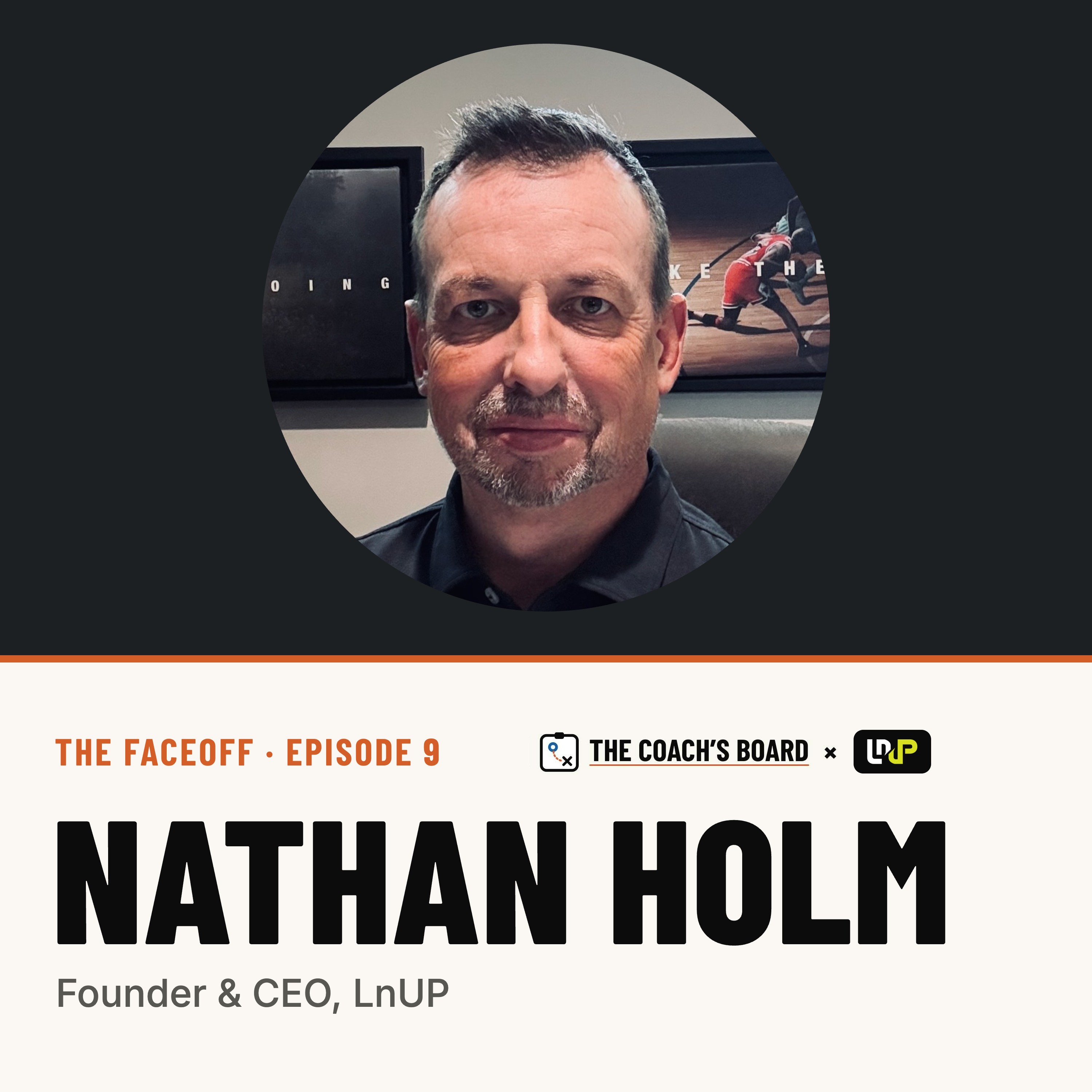
THE FACEOFF · EPISODE 9
Episode 9: Nathan Holm & LnUP — Not a Facility Problem, an Organization Problem
Nathan Holm · Founder & CEO, LnUP
The guest

Nathan Holm
Founder & CEO, LnUP

A first head coaching job at 23. Nearly eight years as an assistant men's basketball coach at Concordia University in St. Paul, while working as a vice president at Axcept Media, an interactive media startup. Then nine years at Upward Sports, the national youth sports nonprofit, as a vice president and then director of operations. Nathan Holm has been on just about every side of the youth sports table. Now he writes The LnUP Letters every Wednesday and is the founder and CEO of LnUP, which helps independent youth sports leaders build stronger organizations behind their programs.
This is Episode 9 of THE FACEOFF: thirty-five minutes with Nathan. Paul sat down as a youth hockey coach who watches a club's youngest group thin out a little more every year, with the question that took over their prep call: what happens when money shows up? Nathan's answer starts behind the program. Facilities and capital pressure are real, he says, but the limiter is usually the organization.
WHAT'S IN IT
• The program is why families choose you. The organization is why they stay. Families choose a program for the schedule, the time, the cost and their goals. Once they're in, that's table stakes, and they stay based on how they feel: valued, heard, seen and moving toward what they came for. Plus the basketball club director at Upward who had hit the cap of what a leader of one can do, and why clubs need non-negotiables and guardrails with room for the local leader's touch.
• Growth produces silence, not noise. As a club grows and leadership gets pushed out, the founder gets insulated, and "I'm not hearing any problems" starts to sound like everything is going great. His fix: psychological safety and real feedback loops, because a director is balancing four scorecards every day: the families, the coaches, the athletes and the organization.
• Youth sports isn't a zero-sum game. In many communities there are more kids looking for a way to keep playing than organizations serving them. Define who your club is uniquely designed to serve, get clear on who you're not for, and take the lesson he borrows from Peter Thiel's Zero to One: go where the competition isn't.
• New money is good news, if the operator is ready. Why the playbook from other industries won't transfer cleanly to youth sports, and the model LnUP is testing now: a partner network of clubs that keep their own brand, governance and 501(c)(3) status while sharing what makes sense to scale, borrowing from the credit union model. "If you want capital to come in, you need to be able to show capital why you've earned the right."
• Prioritize every week, or pay for it in February. His ask for club directors: a block of time every week to name the most meaningful thing to get done and what will move the organization long term. "We don't pay for the sins of October in November. We pay for them in February and March." Plus where AI can already buy a buried director some time back.
• Rapid fire. The best gym he coached in (Williams Arena at Minnesota, raised floor and all), Barnes & Noble's turnaround through its local managers, Good to Great for a first-year club director, the administrator who gets the entry fees paid and the books kept as the most underrated job, and golf 365 days a year on Hilton Head.
FIND NATHAN AND LNUP
The LnUP Letters: https://nathanholm.substack.com
Nathan on LinkedIn: https://www.linkedin.com/in/nathan-holm-547baa/
The written version of this conversation is THE FACEOFF VOL XV, free at https://thecoachsboard.com. If you run a club, a facility, a league or a team, or you're building something for the people who do, we'd like to hear from you.
The Coach's Board is the community building youth sports. Home of The Faceoff Podcast.
Instagram · X · TikTok: @thecoachsboard
Transcript
Paul Variano Welcome in! This is The Coach's Board, the playbook for modern youth sports. I'm Paul Variano, and every episode we sit down with someone who actually runs this game. My guest today has been on just about every side of the youth sports table. He got his first head coaching job at 23 and spent nearly eight years as an assistant men's basketball coach at Concordia University in St. Paul, while working as a vice president at Axcept Media, an interactive media startup. Then he spent nine years at Upward Sports, the national youth sports nonprofit, as a vice president and then director of operations, in a network serving more than 2,000 partner organizations and 250,000 families a year. He was also the founding board chair of its Upward Stars clubs. Along the way, he learned something most of the people listening have learned the hard way: great sports experiences depend not only on what happens on the field or court, but on the strength of the organization behind them. That's his work now. Every Wednesday he writes The LnUP Letters for the leaders building what comes next in youth sports. And he is the founder and CEO of LnUP, which helps independent youth sports leaders build stronger organizations behind their programs. Nathan Holm, welcome to The Coach's Board.
Nathan Holm Thank you, Paul, and really appreciate the opportunity to come on. I've been enjoying and loving your content and getting to hear the stories you've been sharing through both your newsletter and through podcasts.
Paul Variano Thank you, Nathan. Really appreciate those kind words and for you coming on. Really excited for it. So here's why I wanted you on. Most of the people who listen to this run a club, a league, or a program, and almost none of them get into it to run a business. They got into it to be a coach. Then one day, there are 400 families, a spreadsheet, a budget meeting, and a founder who can't take a week off. You spent a decade on exactly that problem, from inside a national organization and now from the outside with your own company. So today, I want your story, what you've learned about what clubs actually need, and then I want to get into the question that took over our prep call. What happens when money shows up? Start wherever the story starts for you. The bench, the startup, pro sports, the nonprofit. How does a basketball coach end up here?
Nathan Holm I've been blessed with diversity of experiences and with a lot of gratefulness to work with and work under a lot of wonderful people that I've learned a lot. Sports has always been a huge part of my life. I think like most people who are involved in this, we began as players and I transitioned fairly quickly after high school into coaching, because I reached my ceiling of athletic ability as I moved into the collegiate level. I was grateful to a head coach there who said, Hey, have you thought of getting into coaching? that was the impetus for it. it's been so many powerful lessons. When I think back the different experiences and I coached everything in basketball. I was a junkie about that when I was starting out and I was coaching every club team from fifth grade through high school, taking AAU teams around the country, got an opportunity to be a high school head coach, would work camps across any college camp and other camps I could. Through all those experiences, I learned a lot about people and preparation that still stay with me to this point. That ability to communicate. with athletes, families, other coaches, athletic directors, those things are invaluable skills that stay with me to this day. Preparation. One of the lessons that I learned and I used to say this to every staff I was a part of, we don't pay for the sins of October and basketball in November.
Paul Variano Mm.
Nathan Holm We pay for them in February and March. Because if we don't prioritize and start preparing and laying the right foundation, those mistakes won't show up necessarily early in the season, but they will show up at the end when it's usually too late for us to do anything about it. So those things stay with me. then the opportunity with Axcept Media in a startup world, you quickly learn the importance of change, adaptation, iteration, how to survive. And there's a lot of parallels in youth sports from a club level with those things. Upward was invaluable in helping me learn scale and systems and the importance of mission and staying aligned to those things. All those things point to the work today is really teaching me a lot more about the importance of local leadership and the context and preserving that context in which they operate their programming.
Paul Variano So while you were coaching at Concordia, you were also, the vice president of Axcept Media and you co-founded LearnCDHC on top of that. What did building businesses teach the coaching mentality in you?
Nathan Holm It's helped me to start approaching each season as a little bit of its own startup rather than, we hear the skills and lessons we've brought from previous endeavors in business, and in the case of basketball, previous teams. But we now have to take a look at, hey, what are the real assets that we need to be highlighting in this season? Same thing as in a business, what are those things that can become our differentiator? really looking at with fresh eyes and not just making assumptions. the other thing that I'd say is startup world helped me apply into coaching in rapid iteration. Don't be afraid to test something, but also don't be afraid to move on when it doesn't feel like it's a good fit with that. So that kind of rapid iteration of experimentation is on the coaching perspective.
Paul Variano So you're out there launching clubs for national organizations with a playbook, and somewhere in those years you met a club that didn't want to use that playbook. Tell me more about that situation. What was different? What did you realize about it?
Nathan Holm Early on looking at how do we scale things and how do we create an alignment under one brand as we're scaling these things, I thought that creating uniformity, I went in with one of the hypotheses or assumptions, that creating uniformity in the sport experience was going to be the big key. And that meant really prescribing how programming was delivered. I was having a conversation with a gentleman who ran a basketball club. He was looking at coming under our brand because he saw some benefits of that and saw definitely alignment missionally with the organization that I wanted to be a part of. But as we started prescribing, he's like, hey, that's not the on-the-court experience isn't what I'm looking for help with. What I really need help with is I've hit my cap right now that the leader of one can do. I'm feeling I'm maxed out, stressed out. How can you help me build an organization around me that allows me to scale the unique sports experience we're doing? I started with the belief that uniformity would be the key to it. I have talked about that I've looked at Chick-fil-A and in the youth sports we see a lot of that of the standardization of some of the delivery experience, which they do a wonderful job on consistency of delivery around. I think there's elements of that that are needed, but there's also a need for the blend of that local leader's touch because that is what makes it unique. So I started focusing more and more on what are the things that are The organizational design and support mechanisms that allow leaders to grow past their current levels.
Paul Variano So you've written the model, you said you were scaling it for corporate, not for the club. When did you say that for the first time out loud? when did that first come to light?
Nathan Holm It was like early on, we were probably at five or six clubs at that point when I started the realization that some of the things that we were focused on in making sure we're creating that uniformity and that standardization. I'm not saying they weren't important, but they weren't the priority that was gonna necessarily drive scale and growth at the rate that we were looking at. that's when having that conversation with that leader really triggered starting to dive deeper and I remember one of the great things that happened was I had an opportunity some of the leaders at Upward to spend some time with the Chick-fil-A leadership team and asking them questions over the course of a day one of the stories that was shared that day was How the daddy-daughter date night concept came out that they roll out across stores nationwide. it was a local owner operator just started doing it. kind of the proverbial ask forgiveness rather than permission. But they took a look at and said, wow, these are elements here that really work. I was like, we really have to start to create an environment where people have that autonomy to experiment a little bit. We wanna set guardrails and create non-negotiables, but then leave plenty of room for some negotiables so that innovation, ideation, personalization, regional differences, community differences can all come into play. I think a key aspect and even within a club itself, I think it's important for the founders, our leaders, our executive directors of those clubs to find ways that teams even within their organizations or programs within it can have that same principle of some level of innovation, personalization, but still maintaining the non-negotiables to the standard of the club.
Paul Variano Nathan, you're an expert in this youth sports expansion strategy space. And you spent decades, providing this advice and consultation. Start with your own company now. It has something to do with surfing. Love for you to share
Nathan Holm Ha ha ha.
Paul Variano with our listeners
Nathan Holm The name is LnUP and we spell it L-N-U-P, but it is Line Up and I wanna clarify first off, I am not a surfer. I have never surfed. I love spending
Paul Variano Ha ha ha ha.
Nathan Holm time and I have the great fortune of living near the Atlantic Ocean now in this life and I love the ocean, but as I was walking, lineup does have a term where I've been told by surfers that I've spoken with that waiting to catch that wave when they're sitting out in the ocean and you see them on the horizon line, sitting on their boards, they're looking for the lineup as they choose the wave that they want to ride in. I looked at this several years ago and that to me was a great metaphor for what was happening in sports. There's so much change going on. You had NIL coming on the scene and what was that happening at the collegiate level and what's going on down at the high school and club level with it. You had a lot of communities seeing a reduction of traditional program providers of schools and municipalities reducing the level of sports and so the privatization of youth sports going on and in a continued growth of athletes and families changing expectations of what they're hoping to get out of a sport experience, that pursuit of college scholarships or professional aspirations and those things all happening. LnUP was really about how do we help athletes, families, coaches, others navigate catching the right wave for them. Because not all waves are the same and not all waves are the right waves ride for each of us to be riding. that's really was the genesis. And then it has a play with the sports of building the right lineup for your team. those type of things. it really was around catching that wave that's gonna propel you to the ride that you're looking for during this short window of your sports experience.
Paul Variano I've got caught in the wave a little bit, through your newsletter that you send out. And I
Nathan Holm Yeah.
Paul Variano was reading through it and I saw one of the things that you wrote was "The program is why families choose you. The organization is why they stay." What's the story behind that? if you can unpack it for a director who thinks the program is the whole job.
Nathan Holm This will tie into something that we may touch on a little bit later that I think is a key concept was around the balanced scorecards. when a family or an athlete chooses your program, they're really choosing it based on what they believe that your program can do for the goals that they have. they're taking a look at and they're choosing and coming in. And it could be a developmental experience because they've heard that this is the best place to get started in our community. It could be a travel team experience because you have college aspirations but they're choosing that program based on the offering you have, that component of schedule, time, cost, all of those things. as we look at them staying, they choose to stay with your program based on how they feel. it ultimately comes down to do they feel valued, do they feel heard, do they feel seen, did they get some of their goals, Your organization's ability to deliver that experience makes them feel heard, seen, and valued is what will determine whether they stay. After they're in part of your program, it's no longer necessarily the things that attracted them of the schedule that you're providing or those type of elements that's the table stakes now to them. But your organization: Is it organized? Does it live up to everything that you're promising and saying? Do we feel that we're being valued and heard for what we're investing into it towards our goals?
Paul Variano I think it goes beyond just what is a sport and dropping your kid off and the babysitting
Nathan Holm Yeah.
Paul Variano of it all. It's more of this interactive experience. The thing I remember the most is about my youth sports experiences. Now there's a whole way to differentiate amongst different club directors, especially with so many different clubs popping up now. The competition to secure a family, not just for one season, but year in and year out. It's a battle. It's a battle for a lot of club directors. I
Nathan Holm Yes.
Paul Variano talked to mine for the organization I coach ice hockey. You bring in a group at the youngest age and usually it's probably one or two of those will end up going through the whole organization at the very end. In building LnUP, you share that it's had a few versions. What did each one of these versions teach you?
Nathan Holm The startup experience helped me previously with that rapid iteration and testing and spent a lot of time going to what is the biggest barriers, obstacles and that can help organizations. What is that true pain point that's a little more universal So we did things where we would work directly with athletes in trying to because the expectation of what composes a sports experience has changed in families' mind. There was a time where it was drop my kid off and it becomes the babysitting thing to now. The on-the-field stuff is just the baseline, but what are you doing from a nutritionist and sports physiotherapist type things. What are you doing for the mindset? How are you helping prepare for NIL opportunities, whatever that might be? How are you helping me balance the multi-sport participation? Each family is different. The one thing I think and I know you've talked about this and with some other leaders when we talk about youth sports, it's not one thing to any one person. There's all these different strata levels of things and families fit in different within that. So we started looking at hey, can we provide some of those things that help that athlete and family and supplement of the club. What's that look like? And we went through a lot of different iterations on what should some of those focuses be and it's really come to this focus where we're at now on how can we help that local leader receive some of the benefits of scale but still remaining independent, not having to give up their independent control and the control of what makes that local experience differentiated for them and their family so that we can increase that quality of that experience for those families. I think the privatization, professionalization, when we've talked about money coming in, I think it's a really good and needed thing. What I want to see preserved is the ability for us to expand the amount of programs and the uniqueness of offerings that are out there, not consolidate and reduce that through it. That's really the work and how we land on what we see as unique and needed at this time.
Paul Variano A lot of things that you have to measure, quality, quantity. And so you've gone about in the four scorecards: the families, the coaches, the athletes, the organizations. Tell me about a day you watch a director try to reconcile all four at once.
Nathan Holm There comes a point, for all club directors when they start to have to deal with the realities of the conflict of the different scorecards. Meaning, you have a parent who's maybe looking at this from their lens of, hey, my child's future opportunities are being limited because of the experience that we're receiving. We have a coach who has got a different perspective on this, and we have an athlete that has a different perspective on that. the club director is trying to navigate and balance all those scorecards on a daily basis within the confines of hey, we have this is the constraint of our available court or facility time. These are the constraints of the budget, these are the constraints of the governing body, the tournament structures we play in, and all those things. it is daily, I would say. It's not just a one time, it's a daily task or just a reality for club directors. You are dealing with the ramifications of all those different scorecards because you have not just the ones within your organization, you're impacted by those changes that are happening to the governing bodies that you're a part of or to the collegiate landscape and all those things trickling down. feedback loops become a huge tool and needed tool for club directors to successfully navigate things.
Paul Variano Communication's really important. And you've written that growth produces silence, not noise. What does that silence sound like and how does a founder hear it in time?
Nathan Holm You see this play out often and I'm not saying that it's avoidable in the early years, but the founder, that club director, is involved in everything. They are interacting in some fashion with most of the programming that's going on. They are either seeing, hearing or touching different things they can deduce that there's potential problems and then get ahead of some of those things. As you expand, as you grow from the ability for that one person to be doing that to now where you have to push that culture out and push that leadership responsibility out. It quickly can become a case where that leader gets isolated and so they can mistake, hey, I'm not hearing any problems. as everything is going great and we're really not a lot of those things have been solved because they're insulated from it. So you have to create an environment where people have that psychological safety to bring issues and surface issues up to you. You have to find ways to get feedback loops and there's no shortage of great tools for gathering feedback from families, coaches, players and staff in real time, implementing the ones that work best for you. But finding a way to make sure that you get feedback and you do take steps as a leader to preserve that is key as you scale from that one hundred to two hundred to four hundred to fifteen hundred type organization.
Paul Variano For founders that's always the scaling issue. I'd love to turn over to the competitor issue. When you do have more money coming into sports, it means there's more teams available, which also means there's a fight for more of the same families that are out there. There's not just more families A club director, how can they differentiate their products teams and clubs?
Nathan Holm For those who've been operating for a long time in the youth sports space, they're seeing probably the emergence in a lot of sports, some not as many, but they're seeing the emergence of a lot of new competition, new clubs, new organizations coming in. It's great because that's coinciding with new athletes coming into that world and looking for the programming. Everybody at all levels, whether you're one of those startup disruptor organizations that usually a lot of times are birthed for a variety of reasons, but often it was that somebody isn't delivering the defined type of experience that they were looking for their child. those disruptive organizations or whether you're one of the well-established, it's easy to start to view it. We come from the sports world. Sports is a zero-sum game. Somebody wins, somebody loses, What I try to get leaders to understand is your club and organization, you don't want to think of it necessarily in a zero-sum game, meaning somebody else doesn't have to lose for you to win if you do this the right way of defining who are you uniquely designed to serve, who is your mission best serving, how can you continue to improve the services of that mission and also starting to learn of who are you not for? That sometimes throws people for a little bit of a loop, but if you try to be the club for everybody, you're probably gonna ultimately start to become the organization for very few or nobody. You have to really design around your core competency. When I say sports isn't a zero-sum game, there are more kids who are looking for ways to continue to participate in sports than there probably are organizations serving in some cases right now. Meaning that not everybody's looking for the same type of experience. I think in most communities there's a critical mass of an organization that's providing just what I'll call localized or competitive rec play. For older ages, There is a lot of different opportunities. And so you have to choose where your market, your expertise and your organization can best serve and then focus on doing that really well and not get as hung up on what are all the other clubs doing. Peter Thiel talked a lot about in his book, Zero to One: find that underserved population and serve it really well is a butchered summation of that, but don't go where all the competition is, go to where it isn't. find how you can differentiate yourself in those spaces.
Paul Variano Peter Thiel's a big money guy, big thinker, big tech guy. I've talked about on the podcast with other guests youth sports is getting the attention with people for money, whether it's foundations, private investors, tech. I wouldn't be surprised if sovereign wealth funds and other asset managers really start to pay attention to it. you've been on the record. in this podcast as saying it's good news. Is it good news? Is it good news for the club director? The parents? For coaches? Some or all?
Nathan Holm I think that new money coming into the space is a good thing. That doesn't instantly mean that good outcomes will be achieved for every person in that chain just because the money comes in. It really comes down to how do we utilize that capital and how is that capital used to deliver a better experience or to enhance the opportunities of experience to bring new people into it. I think it's a reality that I hope does continue in that youth sports is valued in this country and that we need to make sure that we preserve money coming in. We need sustainability for organizations to exist in communities to provide that. I'm in this space because I do believe sports is a powerful platform and I wanna see athletes in every community have the quality and the opportunity expanded, not constricted or constrained in their community. We need people who are bringing a willingness to invest in things into it. But we need organizations then to be good operators of it and good stewards of that. We also need a lot of models for it because it may not look the same. that it does in other industries when that type of private funds, the private equity, the different investment groups come in. The playbook that worked in other industries may not be the complete playbook that works in youth sports because I'll say that youth sports is a unique thing. You have a lot of conflating things. It is a coveted demographic of people because it's families but People are very passionate about their child and that experience. coaches are very passionate about their belief in what is the best way to approach things. they are not as likely to come under. the model itself still operates in a lot of cases on utilization of volunteers or really part-time lower paid people to make this whole thing work. some of the standardization playbooks I think won't be quite as effective. So I think we're gonna need to make some modifications in there so that we can have that good operation.
Paul Variano We want to preserve the incentives for local leaders and leave room to try those different models. I completely agree. bringing private capital in will expand the opportunity and the experience for everyone. I think there's a model that can be done successfully.
Nathan Holm I really don't think that there's a singular model that's gonna serve the youth sports landscape from introductory developmental rec and all the way to club travel elite and the path to professionalization in the sport. One of the things I'm super curious about is what might be some levers that we can aggregate clubs, and so we're doing tests right now, with bringing together some clubs that we are working together as a partner network so to speak, of hey, what are things that we can aggregate at scale, but they still preserve their brand, their governance, their 501(c)(3) organizations. They still preserve all that, but what are the things that we can share. Some of the areas that I'm looking at, when we talk about private capital and the money world, can we learn something from the credit union model. Can we bring together these clubs and that we create shared value through that and we save on some margins, we generate new revenues, and that margin is pulled back not to necessarily the investor of that, but that benefit gets shared back in a larger portion to those organizations that are part of the partner network. How can we aggregate things that make sense to scale while preserving independence? we still have a lot to learn with that, but I'm loving some of the experiments that we're doing with that. It goes beyond just looking at buying group power. That's one little fraction of that, but it is how can we become more appealing to brand partnerships and activations at scale? where it's more meaningful to those brands How can we be at an operational level, help them be more efficient? how can we have idea sharing amongst leaders, and families and athletes and coaches and programming model innovations,
Paul Variano it sounds like it's a lot of stuff outside of just raising registration fees, which is what we hear about so much in the media There's something you said that stuck with me. the constraint isn't capital or facilities, it's whether the operator is ready to run at scale. what does it mean to run at scale?
Nathan Holm In talking to club directors and let me caveat a little bit with two yes, the pressure on facilities and capital that they're experiencing is real and that time constraint is real on them. So when you talk to them, you usually hear their top of the mind and the biggest things like if I just had my own facility or if we had a little more capital so that we could make investments in these things or if I just had more time for me to do that. all those things, when you start to break it down, there are some who really do understand their numbers and understand their strategy and plan. But when we start to peel that back, in most cases the facility may feel like it's their limiter right now, but their limiter is really in their organizational plan and design. for how they can scale to that capacity and how can they create the numbers that make sense to somebody to want to come in and invest or help them find the funding to procure those facilities. We have to step back and go, are you really ready to be because in order to meet the demands you're talking about, you need to double in size or the next X number this time horizon. Are you really ready to do that? Can you grow enough leaders? Because I think one of the keys for club directors and leaders to understand is that they do move into where their primary job is growing leaders that can deliver, make sure that the experience is being delivered downstream. So can you move into how you grow leaders? Can you also move into operationally managing the numbers and truly knowing what levers to pull on? there are programs out there that leaders within their own club that they should be, in my opinion, looking at scaling. when you start to talk with them about, they go, wow, I didn't even realize that. But when you look at the return on both the player experience, the family perception and the revenue generation and profit are all called sustainability numbers for them, the profit numbers, you really need to be pouring the gas to that and maybe just throttling back in these areas. So taking those looks at it from a true business perspective 'cause if you want capital to come in, you need to be able to show capital why you've earned the right and that you can prove that you can get a return on that capital for them.
Paul Variano From a club director's perspective, I think that's some really good advice. I'll also say it sounds like a lot of work and very laborious. there's only so many hours in the day, hundreds of families, thousands of kids, dozens of coaches to help lead Where does technology actually help a club? where is it just one more vendor email?
Nathan Holm One of the signs that a lot of money is coming into the sports space is that not just in the programming area but all the support things around it. I had a club director in a recent conversation say, What's going on? Like I'm getting so many emails and cold outreaches on all these new services, products, tech offerings and everything in the sports space. I'm a big believer that technology can help club directors greatly reduce especially as some of the tools that are being developed with AI greatly address some of that time constraint that they're talking about. I also think it can help them address some of the cost containment issues that they want to preserve. There's a lot of tools that can be developed very low cost for them or that they can adopt that others have already developed that will free up a lot of time that on routine tasks that they're dealing with. club directors, I don't think most people and families who are in it understand the amount of the bombarding that club directors get on emails, texts, calls, on all all those things. if we can start to utilize AI to bundle things, trend things, even create some responses and also help shuffle to delegations and different things that way. that's just one tiny example of a way in which technology can start to free up directors and leaders in youth sports.
Paul Variano if coaches like myself are using it as we're teaching our players, whether it's video review, scheduling software that's out there, or even like a simple chatbot, For club directors, if there's any entrepreneurs thinking about a product to build, make a chatbot for club directors to be able to answer parents, coaches, and other clubs. Could be the next
Nathan Holm Absolutely.
Paul Variano unicorn in the sports space. Before I let you go and before we ask you for your final piece of advice, where do you see the vision for LnUP?
Nathan Holm We're going to stay focused on how can we help leaders, how can we create aggregation for economy of scale benefit for them? How can we bring and unite those independent leaders to receive that benefit? How can we make it easier for brands and others to get involved to help bring new revenue to that local club level that's gonna remain our focus. It's One of the things that I talk about with the team here at LnUP we spend a lot of time with in the strategic advisory with clubs that you gotta prioritize and you can't tackle everything because like you said, the whole thing can feel laborious and they don't have much time. we have to prioritize what's the first domino that has to fall, what are those keys? I said we have to eat our own dog food here internally too. We have to make sure that we stay focused on what's the biggest priority. starting with these pilot organizations, helping them receive that benefit and continuing the strategic advisory work with club directors to help us continue to learn but uncover and innovate new ways to add value
Paul Variano you've got a room full of club directors to stand in front of the week after this comes out. Something that they can work on.
Nathan Holm There's so many things. I would encourage leaders of anything and particularly club sports, and it's valuable for myself, I know, is find time every week, either at the end or the beginning of the week to prioritize: what is the most meaningful thing that I need to accomplish this week What is the thing that's gonna move long term? Step back and look at it from a higher point of view because you'll never be at a shortage of urgent things to deal with. make sure you spend time identifying what's the most important thing to work with. That has to happen that week. And take a look at not just on the short-term horizon, but look at a long term. Because the same principle of that as a coach I learned painfully. And that's why I became principled that you pay for the sins of October, not in November, but in February. The same thing with organizations. We don't necessarily pay for the mistakes we make in prioritization in the near term, but we will certainly feel their impact in the longer term. So we need to spend some time each week looking at what's most important.
Paul Variano It's prioritization, it's delegation, it's project management, Before we let you go, rapid fire, five quick ones, the first thing that comes to mind. The best gym you ever coached in?
Nathan Holm I would say the Williams Arena at the University of Minnesota's campus. I've coached in a lot of really cool gyms, but that one's nearing a hundred years old now, I think. It has a raised floor and we got to coach a tournament the University of Minnesota was hosting in basketball several years ago, played three games there. that was an incredible experience.
Paul Variano Chick-fil-A or Barnes and Noble, which taught you more about youth sports?
Nathan Holm Learned a lot from both. I would say I probably am spending more time thinking about what Barnes and Noble did in the localization and empowering the local managers is consuming more of my thoughts as looking at how that organization turned itself around and one of those levers was that localization. But there's a lot of gems to be learned from the consistency of service and standards that Chick-fil-A has done.
Paul Variano The business book you'd hand a first-year club director, and you can't say Barbarians at the Gate. I don't know if too many people will be happy with that answer.
Nathan Holm I actually just reread Barbarians at the Gate earlier this year. but no, it would not be that. I guess I would probably say, first-year club director, Good to Great. I want them to start to think about laying the right foundation and the importance of The right principles, the twenty-mile marches, the prioritization and the differentiation that's needed to be successful long term.
Paul Variano The most underrated job in a youth sports organization?
Nathan Holm From what I would say in my own experiences it's that administrative role. That person who is making sure all of the behind the scenes stuff are taken care of, tournament entry fees are taken care of, the coaches are paid, all of that administrative and the bookkeeping is being done, is usually an unsung but highly invaluable role. they're the ones that free up the directors and others to do the things that make that club really hum from a family and athlete experience.
Paul Variano Last one here, The best thing about running a company from Hilton Head?
Nathan Holm The best thing about it is I grew up in landlocked Minnesota outside of the Twin Cities like my wife did as well. And so probably the best thing is she loves the ocean. I love to play golf when I have time, and so we've got the best of both worlds. I love the north, I love Minnesota, but I don't miss the winters. I like being able to play golf 365 days a year.
Paul Variano I'm the same way. Next time I'm in Hilton Head you have to take me out for a round.
Nathan Holm I would love to do that. I saw the clubs back there. I was thinking the exact same thing. We need to get out and play, Paul.
Paul Variano Awesome. And last one, and it's a plug because you've earned it. Nathan, where can people find you and LnUP?
Nathan Holm You can find LnUP at our website, theLnUP.com. That's L-N-U-P dot com. as you mentioned earlier, The LnUP Letters is something that goes out weekly. That's The LnUP Letters. You can just search that or nathanholm dot substack dot com. if you happen to be one of those leaders, I get out to a lot of events and conferences. In fact, I think right after this is aired, I'm gonna be at One put on by the Institute of Youth Sports Leaders. that's their Lead and Evolve conference down in Austin, Texas. if you're listening, you're one of the leaders who's gonna be at that. I'd love to make a connection and get to know more about you and your program there. I'm pretty active on LinkedIn is another great spot to find me, just Nathan Holm at LinkedIn.
Paul Variano Nathan Holm, CEO and founder of LnUP, thank you. This was a great one.
Nathan Holm Paul, so appreciate the opportunity to connect with you and your audience. You're doing a great job. I can't stress enough the value that people like yourself are bringing to what I think is a key element, which is the sharing of conversations, knowledge and information around so that we can all learn from each other and get better to really create great experiences in youth sports.
Paul Variano Thanks again, Nathan. for those of you watching, thanks for listening. If you enjoyed today's Faceoff with Nathan Holm of LnUP, here's the best way to support the show. Check out thecoachsboard.com, where the newsletter is free and wherever you follow along on YouTube, Spotify, Apple Podcasts, Instagram, TikTok, or LinkedIn, hit subscribe or follow. Give this one a like and leave us a comment. Takes 10 seconds, and it's the best way to support what we're building. Every week we sit down with a founder or leader in youth sports and hear their story. The journey, the wins and misses, honest conversations with honest people. One more thing: we're looking for our first brand sponsor. If your brand sells into youth sports, This is the room to be in. The people listening run clubs, coach teams, operate facilities and organize leagues, and one club director buys for hundreds of athletes. Our founding partner gets an ad reading every episode, a spot in our official partners page, and short clips promoting the brand across our socials. And you'd be on the ground floor building it with us. Reach out to us at thecoachsboard.com/partners. And be sure to tune in on Monday when Diyana Georgieva joins us. Her company CUGGO makes a zero-sugar hydration drink mix for active kids, and she's building it with her husband and their two kids on a mission to help families be sweet smart. Thanks and have a great week.