
SBJ Game Changers 2026 · 3:00 p.m. · The New Playbook for College Athletics
Vanderbilt's AD: If We're Not Careful, Women's and Olympic Sports Lose
From the college athletics panel, and the numbers behind it: schools paid athletes $1.8 billion in revenue sharing's first year, most of it to football and men's basketball.
Reported at Sports Business Journal's 2026 Game Changers Conference · Oct. 1, 2026 · New York Marriott Marquis
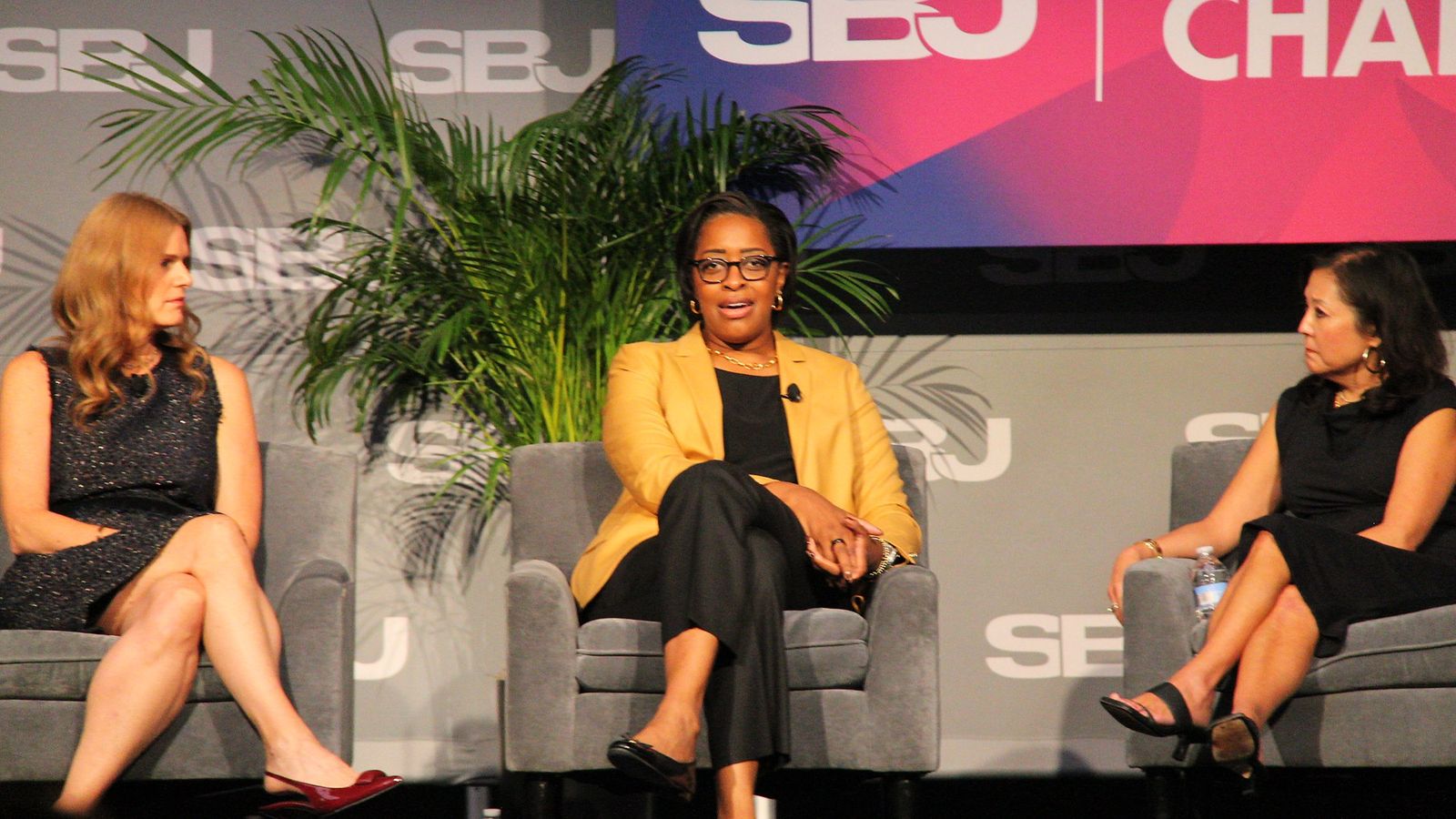
On stage: Candice Storey Lee, vice chancellor for athletics and university affairs and athletic director, Vanderbilt · Kim Damron, president of sports properties, Learfield · Colleen Garrity, SVP of marketing, Excel Sports Management · Moderator: Rachel Axon, Sports Business Journal
Axon asked the question hanging over college sports: as more money flows to football and men's basketball through revenue sharing and NIL, how do schools keep everything else viable?
Lee said her job is hard because all things have to be true at once. The sports that generate revenue require real support. Vanderbilt is also "committed to broad-based programming," she said, across 17 sports, 11 of them for women. "I feel like it's our responsibility to figure it out."
One answer is Anchored for Her, a $50 million campaign for women's athletics that Vanderbilt announced in February. Lee described it as the school's contribution to a broader responsibility to women and girls in sport, one that doesn't go away because schools have to make sound business decisions about where revenue comes from.
"If we're not careful, people will lose opportunities, and those will be Olympic sports and women's sports," she said.
Recruiting has changed, too. One panelist said it has become "a lot more transactional," with athletes weighing what they can earn more heavily than a coach or a system. Lee said athletes' reasons for choosing a school may be different now, but schools still have to support them. In men's basketball, the panel noted, more players are staying in school longer.
The panelists closed on courage: this moment, they agreed, calls for leaders willing to put athletes first. "The well-being of the student-athlete needs to be the priority, and we can't lose sight of that," one panelist said.
The numbers behind the question
The panel's worry has numbers behind it. In the first year of revenue sharing under the House settlement, schools paid athletes $1.8 billion directly, the College Sports Commission reported on Oct. 1. The money went to 34,915 athletes at 307 schools, and 68 schools hit the $20.5 million cap or came within 5% of it.
Most of it goes to two sports. An Opendorse analysis of 100 Division I programs last fall found football taking about 64% of revenue-share dollars and men's basketball 21%. Women's basketball got 8%, and every other sport combined got about 7%. At North Carolina, football and men's basketball accounted for all but $500,000 of the school's allocation, WRAL reported in May.
Some schools have already cut. More than 40 Division I Olympic sports programs, including swimming, tennis and track, were dropped between May 2024 and July 2025, according to a Bloomberg Law count cited by WRAL.
Title IX and Congress
How Title IX applies to revenue sharing is still unsettled. In January 2025, in the Biden administration's final days, the Education Department said payments from schools to athletes count as financial aid that Title IX requires be split proportionately between men and women. The Trump administration rescinded that guidance in February 2025. Separately, a group of women athletes appealed the settlement to the Ninth Circuit, arguing its back-pay formula shortchanges female athletes by about $1.1 billion.
Congress may step in. The Senate passed the Protect College Sports Act 77-22 on Sept. 28. On top of the revenue-share cap, it would add a new retention fund and $5 million for women's and Olympic sports, and it would require schools to keep minimum sport offerings and baseline roster sizes and scholarships in those sports. The House isn't back until Nov. 9, and the bill dies if it isn't enacted by Jan. 3.
Vanderbilt's bet
Vanderbilt is spending in the other direction. Anchored for Her, launched Feb. 4 with a $50 million initial goal, covers endowed scholarships, coaching and staff positions, a performance center for women's and Olympic sports, and a fund for NIL support. SBJ named Lee its Athletic Director of the Year in June. A former captain of the Commodores women's basketball team, she marks 30 years at Vanderbilt this year as an athlete and administrator.
The pipeline at stake
College is where most U.S. Olympians come from. About 75% of the 2024 U.S. Olympic team had competed in college, and 385 of its 592 athletes had competed in NCAA varsity sports, the NCAA said.
The Coach's Board take
Lee's warning runs downhill. If college Olympic and women's programs shrink, so do the roster spots and scholarships that make club and high school pathways in those sports worth what families spend on them.
More from SBJ Game Changers 2026
- 8:45 a.m. · The Val Ackerman Legacy of Leadership AwardVal Ackerman's Rules for the Long Game
- 9:10 a.m. · Top of the AgendaHockey Romance, Stadium Takeovers and the Squeezed Middle
- 9:50 a.m. · Bridging the GapTwo Partnerships Built Around What Players Actually Needed
- 10:25 a.m. · SBJ Connect · Photo essayPick a Neighborhood, Find a Table: Inside SBJ Connect
- 11:20 a.m. · From Activation to ImpactFord Gave LPGA Rookies Broncos. The Bigger Gift Was Mentors.
- 11:40 a.m. · One-on-One with Kristin LemkauKristin Lemkau on Messy Careers, Mediocre Teams and Athletes' Money
- 12:10 p.m. · Leading a Modern Sports FranchiseShelly Cayette-Weston's Hornets Playbook: Fill the Building First
- 1:50 p.m. · Leadership Lessons from a TrailblazerKim Ng on Getting Rejected in Public, and Saying Yes to Softball
- 4:00 p.m. · The Human EdgeThe AI Panel's Rule: Start With the Problem, Not the Tool
- 4:30 p.m. · The New Wager LandscapePrediction Markets Pitch Engagement. A Banker Warned of a Reckoning.
Join youth sports leaders reading every issue.